Michael (United States, 2026)
April 23, 2026
The sole reason for Michael to exist—and the only legitimate way in which the movie can be enjoyed—is as a cocktail of nostalgia and musical appreciation. This truncated hagiography bends its knee to the myth of Jackson before tabloid headlines began sullying his reputation. The movie, directed by Antoine Fuqua and written by John Logan, sidesteps anything that could remotely be considered controversial. This is achieved by ignoring various milestones and oddities, stopping the primary narrative at the conclusion of the 1984 Victory Tour. Consequently, Jackson comes across as a hugely popular performer struggling with Daddy issues.
The film ends with a cryptic reference to a possible sequel. According to some sources, Fuqua's original cut was four hours long and encompassed a much larger portion of Jackson's life. Lawsuits allegedly forced a major reshaping of the film as well as the removal of a decade's worth of story. If Lionsgate sees value in moving forward with a second installment, the material may exist. The question remains whether a continuation could possess the nuance and insight currently lacking from Michael.
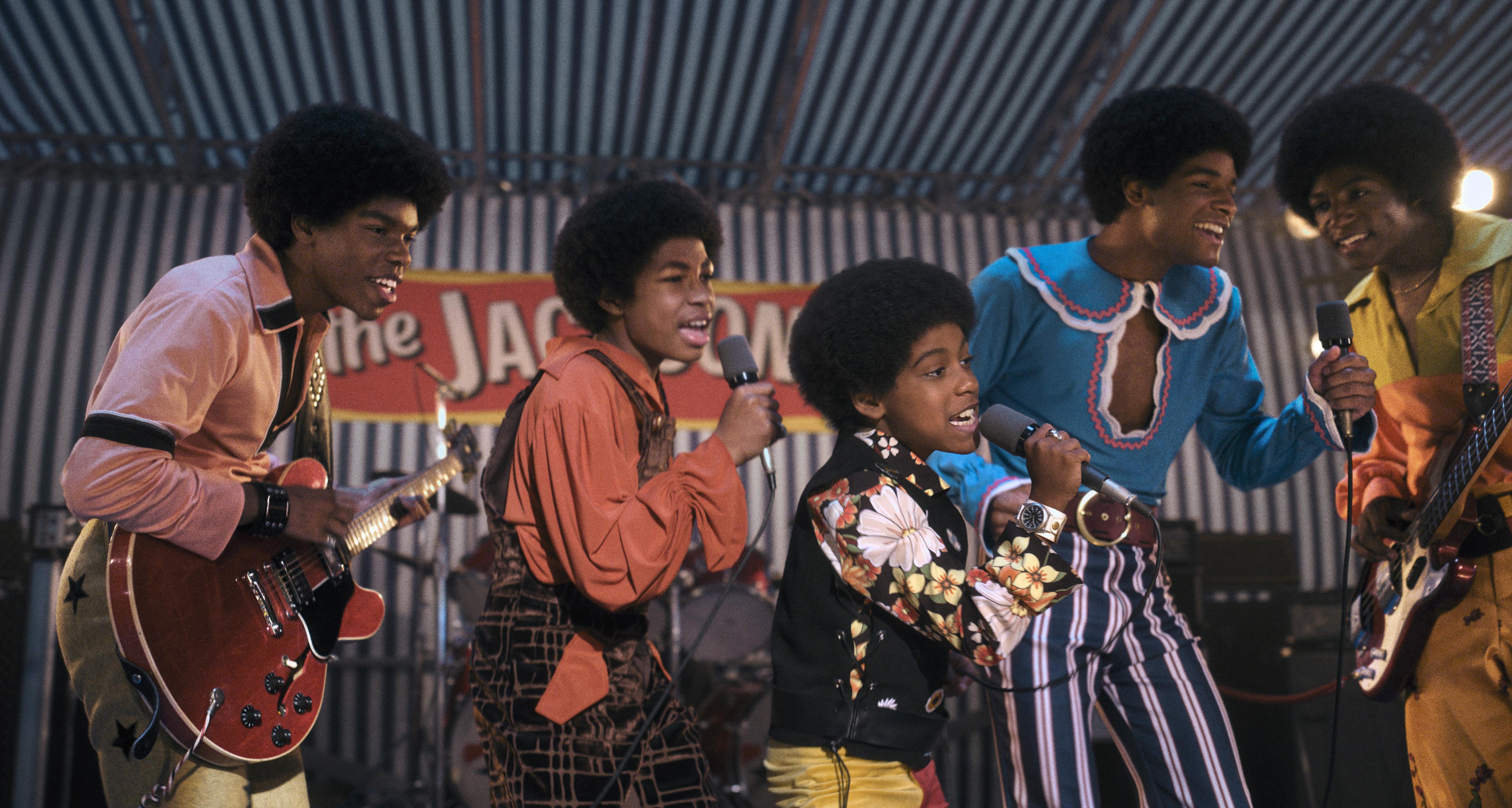 The film is dramatically simplistic and thematically bland.
It offers little that is not already public record; perhaps the only relatively
fresh information is how MTV initially resisted airing Jackson's videos due to
racial barriers. This is mostly a jukebox movie elevated by occasional dramatic
beats. It is structurally unsound, attempting to condense approximately 18
years of chronologically linear material (excluding the 1988 epilogue) into
just over two hours. The central conflict is the psychological battle of wills
between the naive, submissive title character (played by Michael's real-life
nephew, Jaafar Jackson) and his abusive, aggressive father, Joe (Colman
Domingo). The movie ends once this tension has seemingly been resolved.
The film is dramatically simplistic and thematically bland.
It offers little that is not already public record; perhaps the only relatively
fresh information is how MTV initially resisted airing Jackson's videos due to
racial barriers. This is mostly a jukebox movie elevated by occasional dramatic
beats. It is structurally unsound, attempting to condense approximately 18
years of chronologically linear material (excluding the 1988 epilogue) into
just over two hours. The central conflict is the psychological battle of wills
between the naive, submissive title character (played by Michael's real-life
nephew, Jaafar Jackson) and his abusive, aggressive father, Joe (Colman
Domingo). The movie ends once this tension has seemingly been resolved.
Fuqua rifles through Jackson's back catalog, starting with The Jackson 5 and continuing through his early solo work. Most of the blockbuster hits receive at least a few bars, with some getting a full or nearly full rendition. The movie concludes with a flash-forward to 1988 to include a performance of "Bad." Not surprisingly, a significant amount of time is spent navigating the Thriller era, including a partial recreation of the title track's iconic music video. This prompts a fair question: why would anyone want to watch a remake of something so easily accessible in its original format? Although the physical work in Michael is provided by Jaafar, the vocals are all the original recordings. Fuqua avoids compounding the film's flaws by refusing to turn the soundtrack into a cover album.
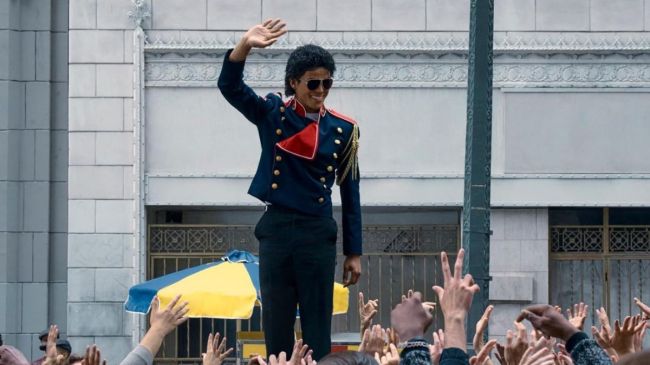 Jaafar's performance falls into the category of mimicry. He
demonstrates great physicality but offers limited depth in his acting.
Furthermore, while there is a familial resemblance, he does not look enough
like his uncle to sustain the illusion, except perhaps when wearing sunglasses.
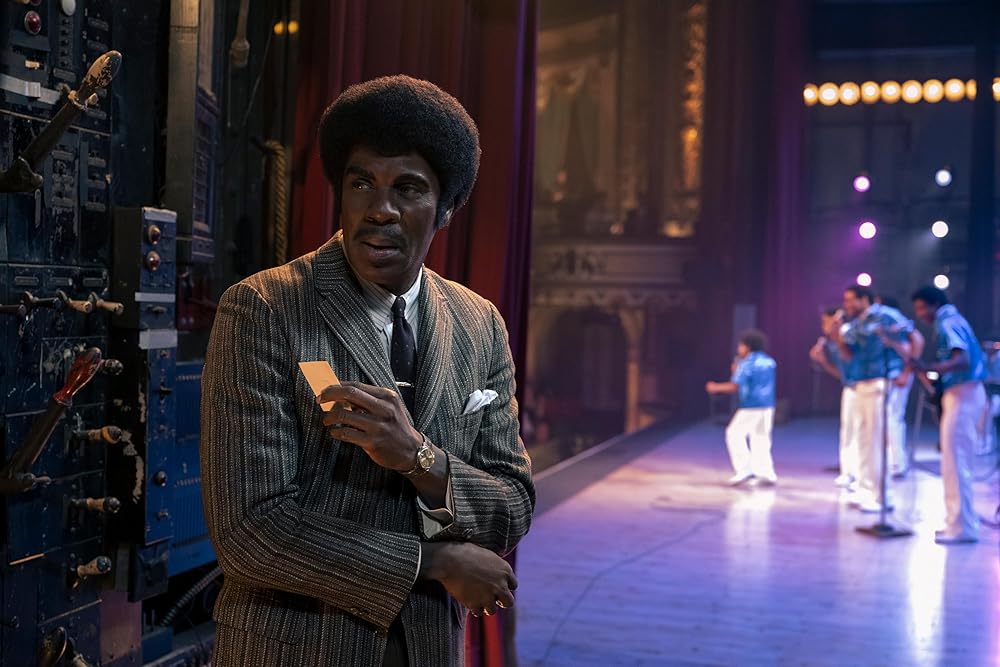
Jaafar's limitations are particularly evident when he shares the screen with
Colman Domingo. Domingo delivers a towering performance—albeit just a tick away
from a full caricature—that operates on a completely different level. The movie
also features appearances by Nia Long as Michael's supportive mother,
Katherine, an unrecognizable Miles Teller as attorney John Branca, and Mike
Myers as CBS Records President Walter Yetnikoff.
Jaafar's performance falls into the category of mimicry. He
demonstrates great physicality but offers limited depth in his acting.
Furthermore, while there is a familial resemblance, he does not look enough
like his uncle to sustain the illusion, except perhaps when wearing sunglasses.
Jaafar's limitations are particularly evident when he shares the screen with
Colman Domingo. Domingo delivers a towering performance—albeit just a tick away
from a full caricature—that operates on a completely different level. The movie
also features appearances by Nia Long as Michael's supportive mother,
Katherine, an unrecognizable Miles Teller as attorney John Branca, and Mike
Myers as CBS Records President Walter Yetnikoff.
 There are at least two glaring omissions. The first is the
complete absence of the second-most popular Jackson sibling, Janet. The
character never appears and is never mentioned by name. One assumes this is the
result of legal complications and that her removal may have been one of the
many alleged changes made during post-production. The second is the decision to
treat Jackson's sexuality as a third rail. The movie completely neuters
Jackson, turning him into a eunuch. It exhibits no curiosity about his sexual
inclinations or personal life. Considering how many of Jackson's later
scandals—such as his marriage to Lisa Marie Presley and various
allegations—were related to his private life, this absence in Michael is
too glaring to ignore.
There are at least two glaring omissions. The first is the
complete absence of the second-most popular Jackson sibling, Janet. The
character never appears and is never mentioned by name. One assumes this is the
result of legal complications and that her removal may have been one of the
many alleged changes made during post-production. The second is the decision to
treat Jackson's sexuality as a third rail. The movie completely neuters
Jackson, turning him into a eunuch. It exhibits no curiosity about his sexual
inclinations or personal life. Considering how many of Jackson's later
scandals—such as his marriage to Lisa Marie Presley and various
allegations—were related to his private life, this absence in Michael is
too glaring to ignore.
Those with a fondness for Jackson's music, especially his pre-1985 catalog, will find enough in the film to avoid boredom. Fuqua shows an aptitude for high-energy performance scenes, and the music remains as resonant in 2026 as it was four decades ago. However, the movie is ultimately a disappointment because of the compelling material left untouched. When compared to the recent influx of musical biopics, this one sits somewhere in the middle; there is too little depth to elevate it to the top, but the soundtrack is too strong to let it sink to the bottom. Even if a sequel already exists in some form, I would just as soon give it a pass.
Michael (United States, 2026)
Cast: Jaafar Jackson, Colman Domingo, Nia Long, Miles Teller, Laura Harrier, Juliano Krue Valdi, Kendrick Sampson, Larenz Tate
Screenplay: John Logan
Cinematography: Dion Beebe
Music: Lior Rosner
U.S. Distributor: Lionsgate
U.S. Release Date: 2026-04-24
MPAA Rating: "PG-13" (Some thematic material, language, and smoking)
Genre: Drama/Musical
Subtitles: none
Theatrical Aspect Ratio: 1.85:1
- (There are no more better movies of Jaafar Jackson)
- (There are no more worst movies of Jaafar Jackson)
- Boiler Room, The (2000)
- Best Man, The (1999)
- (There are no more better movies of Nia Long)
Comments