Mouse (United States, 2026)
November 11, 2026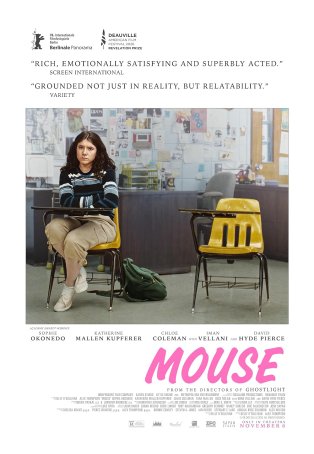
Spoiler Alert: It's virtually impossible to discuss Mouse in a meaningful way without making a revelation that some might consider to be a spoiler. It happens early in the film, so (at least in my view), it's fair game, but I put this warning here for anyone who wants to go into the film completely unaware of things that transpire.
Mouse is a coming-of-age story filtered through the lenses of grief and co-dependency. The screenplay, written by Kelly O'Sullivan (who co-directed with her partner and frequent collaborator, Alex Thompson), emphasizes authenticity and emotional precision over overwrought melodrama and manipulation. Continuing the thematic focus on loss that defined their previous feature, Ghostlight, the filmmakers reject cliches, expanding characters who initially seem to be high school movie stereotypes into rounded individuals.
The film is remarkable for the way it draws the viewer in. We feel the characters' grief and accompany them on their emotional journey to a place where they can move forward without feeling guilt about continuing their lives. O'Sullivan and Thompson accomplish this, however, without resorting to the usual heartstring-pulling. Yes, there are moments when the characters become emotional, but these are played small rather than writ large. The tears, when they come, feel genuine and earned rather than performative.
The movie opens with an extended prologue that introduces us to Minnie Dunn (Katherine Mallen Kupferer) and her lifelong best friend, Callie Bell (Chloe Coleman). Minnie is the shadow cast by Callie's light. They are in many ways opposites, but they love each other all the more deeply for it. Callie has other friends—popular girls like Cara (Audrey Grace Marshall)—who tolerate Minnie because she's practically attached at the hip to Callie. Then, in an off-screen moment, Callie is gone, killed in an early-morning car crash. And Minnie's world goes into a tailspin.
 In the aftermath, everything changes for Minnie, though not
all for the worse. She finds companionship with Callie's mother, Helen (Sophie
Okonedo), the only other person who seems to share the depth of her grief.
Without being aware of it, the two begin to rely on one another in ways that
aren't healthy. Minnie finds in Helen an attentive maternal figure to replace
her own biological mother, Barbara (Tara Mallen, Kupferer's real-life mom), who
seems distant and clueless. Meanwhile, Helen sees Minnie as someone who can
soothe the ache of no longer having her daughter in the house. However, while
Helen remains stuck in the past, Minnie finds ways to move forward, the most
hopeful of which is forming a tentative romantic attachment to Kat (Iman
Vellani), a girl she meets at a video store. (It's 2002, so those places still
existed.)
The overwhelming strength of Mouse is how real everything seems, from the characters' actions and interactions to the ways they show (and sometimes don't show) emotion. We spend almost the entire film with Minnie, and it doesn't take unnecessary verbosity to provide a window into her feelings. Helen starts out as a barely realized authority figure existing in the background, but her character is expanded over the course of the film's two hours. The lead actors—Kupferer and Okonedo—are well-chosen. Both inhabit their characters, expressing trauma in recognizable ways. Kupferer captures the awkwardness of a teenager who has lost her social anchor and must figure out who she is on her own terms, while Okonedo conveys the quiet desperation of a woman trying to delay the reality of an empty house.
 The opportunity is rejected to use shorthand for some of the
supporting characters. I'm thinking in particular of Minnie's mother, Barbara;
Callie's boyfriend, Brad (Beck Nolan); the school's "mean girl,"
Cara; and the theater teacher, Mr. Murdaugh (David Hyde Pierce). All could
easily have slid into their types, but the filmmakers give them moments to
escape those conventions and do more with seemingly stock roles. Brad's grief,
and his unexpected reaction to it, is given room to breathe. Cara has trouble
reconciling her legitimate sadness with her friends' expectations of her based
on her position in the school hierarchy. And Barbara turns out to be more
invested in her daughter's well-being than one initially supposes. In many
ways, it's the care taken with these secondary figures that makes the film feel
so lived-in.
Mouse is deeply moving, but not in the sudsy way that too many dramas are. O'Sullivan and Thompson find an in-between pitch that avoids becoming an overt tear-jerker while at the same time inviting the viewer to take Minnie's journey. We feel her loss alongside her. And although Callie is only on screen for a short time (though long enough for Coleman's performance to leave an indelible impression), her presence is felt throughout. The truth of Mouse and the low-key yet powerful way in which it unfolds make it one of the year's most memorable motion pictures.
Mouse (United States, 2026)
Cast: Sophie Okonedo, Katherine Mallen Kupferer, Chloe Coleman, Tara Mallen, Beck Nolan, Iman Vellani, David Hyde Pierce, Audrey Grace Marshall
Screenplay: Kelly O'Sullivan
Cinematography: Nate Hurtsellers, Luke Dyra
Music: Hamilton Leithauser
U.S. Distributor: IFC Films
U.S. Release Date: 2026-11-13
MPAA Rating: "R" (Language, some sexual references and teen drinking)
Genre: Drama
Subtitles: none
Theatrical Aspect Ratio: 1.85:1
- (There are no more better movies of Katherine Mallen Kupferer)
- (There are no more worst movies of Katherine Mallen Kupferer)
- Dungeons & Dragons: Honor Among Thieves (2023)
- (There are no more better movies of Chloe Coleman)
- My Spy (2020)
- Marry Me (2022)
- (There are no more worst movies of Chloe Coleman)
Comments