Wicker (United Kingdom/United States, 2026)
October 22, 2026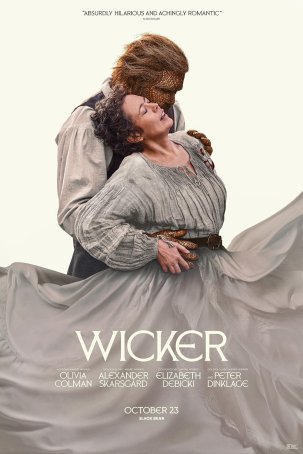
Real-life married filmmakers Alex Huston Fischer and Eleanor Wilson have provided a surprisingly faithful adaptation of Ursula Wills-Jones's short story, "The Wicker Husband." Although Wicker describes itself as a "fable," it is at its sharpest when operating as a satire. Because the film leans so heavily into metaphor, it shortchanges character development, so its attempts to engage the audience on an emotional level meet with only middling success. The final half-hour runs into particular trouble, hinging on an overwrought character choice that strains credibility while suffering from the manufactured need for a single obvious villain.
For roughly the first half, Wicker offers a fresh, breezy takedown of patriarchal societies, complete with wedding collars (instead of rings) and women who surrender far more than just their surnames to their husbands. The satire is pointed and frequently funny—an over-the-top scene featuring Richard E. Grant is hilarious in a nearly Monty Python-esque way. Once the narrative asks us to buy into a genuine romance, however, that aspect falls flat. The problem isn't that Alexander Skarsgård's character looks bizarre, but that less effort went into developing his persona than crafting his costume. For the emotional beats to work, the movie needs us to believe that he is more than a doll—that he possesses real autonomy and agency—and that never really happens.
 The story transpires in a conservative, medieval village
where women serve two primary purposes: to bear and rear children, and to help
build their husbands' careers. The Fisherwoman (Olivia Colman) has lived well
into middle age free from the yoke of marriage—and is all the happier for it.
She absorbs the townspeople's japes—that she is odd, smells of fish, and
remains somehow unfinished without a spouse—with little apparent concern. Then,
seemingly on a whim, she makes an unusual request of The Basketweaver (Peter
Dinklage): to use his magical talents to fashion her a husband. He accepts the
challenge and, one month later, in true Frosty the Snowman fashion, The Wicker
Husband (Skarsgård) comes to life. Unlike Frosty, he doesn't melt; instead, he
talks, tackles manly chores like fixing the bed and repairing the roof, and
helps The Fisherwoman discover pleasures under the sheets she had never
previously dreamed possible. Soon, envy, jealousy, and curiosity set the
townsfolk's tongues wagging.
One niggling issue with a satire like Wicker is that the world-building isn't immersive enough to chase away distracting practical questions: What happens when he downs a pint at the pub? How does The Fisherwoman avoid internal injury during sex? Why does a woven construct need to sleep? Trivialities like these rarely register when a film casts a strong enough spell. Comedy neuters logic, while drama courts it, and Wicker's attempt to blend both registers creates an imbalance that invites the viewer to wonder about such things.
 Whether intentional or not, the film also functions as an
allegory for one of the hot topics of the day: artificial intelligence.
Although The Wicker Husband is woven from wood and imbued with magic, he serves
as a fitting stand-in for an AI-powered companion—programmed to take
instruction, do no harm, learn on the fly, and exist solely to please. On that
level, Wicker opens up provocative possibilities that are left
frustratingly unexplored. In fact, one of the biggest issues with the film
overall is how shallowly it exploits the rich tapestry that forms its backdrop.
Ultimately, the movie is more frustrating than anything else, squandering so much unrealized potential that the final result leaves one hungry for more. The film's villainess, The Tailor's Wife (Elizabeth Debicki), is more petty than menacing, and her nastiest scheme feels forced and unlikely; The Fisherwoman must act out of character solely because the plot demands it; and The Wicker Husband never evolves beyond what he was the moment his Geppetto let him out into the world. Compounded by an inconsistent tone, the actual movie simply doesn't do enough with its intriguing premise to justify anything stronger than a middling reaction.
Wicker (United Kingdom/United States, 2026)
Cast: Olivia Colman, Alexander Skarsgård, Peter Dinklage, Elizabeth Debicki, Richard E. Grant
Screenplay: Alex Huston Fischer, Eleanor Wilson, based on the short story "The Wicker Husband" by Ursula Wills-Jones
Cinematography: Lol Crawley
Music: Andrew Orkin
U.S. Distributor: Black Bear Pictures
U.S. Release Date: 2026-10-23
MPAA Rating: "R" (Sexual content, language, and brief full nudity)
Genre: Fantasy/Satire/Romance
Subtitles: none
Theatrical Aspect Ratio: 1.85:1
- (There are no more better movies of this genre)
- (There are no more better movies of this genre)
- Three Billboards Outside Ebbing, Missouri (2017)
- Avengers: Infinity War (2018)
- X-Men: Days of Future Past (2014)
Comments