You Can See Everything (United States, 2026)
October 17, 2026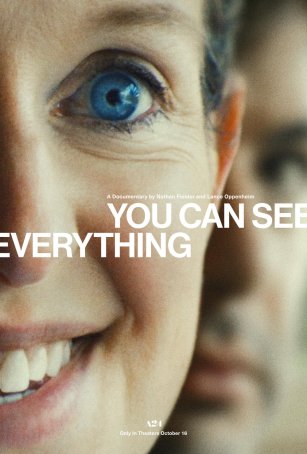
[Spoiler Alert! This review reveals one of the film's surprises, although it's already "out there," so to speak. Nevertheless, reader caution is advised. If you want a completely fresh experience, I recommend seeing the film first.]
In the beginning, You Can See Everything may have been intended as a somewhat straightforward documentary about Theranos CEO Elizabeth Holmes. The seeds of that approach are evident in some of the early scenes. However, the end result is unlike any documentary I have seen, precisely because it isn't one—at least not in a traditional sense. It has more in common with reality TV; although there are non-fiction elements in the final project, it leans heavily into scripted material and improvisation with a huge dollop of meta on top.
Nathan Fielder structures the first third of the film almost as a "hangout" movie, inserting himself into the action. A lot of material that might have ended up on the cutting room floor remains in the final print, offering evidence of the film's shifting priorities. This results in a meandering tendency that represents both a strength and a weakness. While allowing the viewer to become more fully immersed in whatever reality You Can See Everything is creating, it makes the movie feel a little longer than necessary. I'm convinced that more aggressive trimming would not have broken the sense of immersion.
Early in the proceedings, the movie appears to address the question of Holmes' guilt – whether she is truly the woman portrayed in the media, or if that is a misrepresentation amplified by Amanda Seyfried's portrayal in the TV miniseries The Dropout. Fielder and co-director Lance Oppenheim (who recently made his non-documentary feature debut with Primetime) let Holmes tell her story, focusing on her wide-eyed, often-bewildered expression, but they never get a definitive answer—in part because the issue ultimately becomes secondary. The final verdict about Holmes is left up to the viewer: is she a high-functioning autistic individual who was manipulated by everyone around her, or a master manipulator herself? Is this intended to be her confession or a major PR move?
 There is compelling material in the first 75 minutes, even
if it ultimately serves as a prelude. The film's introductory act provides a
fly-on-the-wall perspective of the interactions among the principals:
Elizabeth; her partner, Billy Evans; and their two children. Fielder, even when
living with them, is always the outsider, and there is an increasing sense that
Billy is trying to control the narrative. While Elizabeth remains something of
an enigma, he is more transparent—sometimes literally, as evidenced by a
full-frontal shower scene that invites all sorts of metaphorical
interpretations.
There is compelling material in the first 75 minutes, even
if it ultimately serves as a prelude. The film's introductory act provides a
fly-on-the-wall perspective of the interactions among the principals:
Elizabeth; her partner, Billy Evans; and their two children. Fielder, even when
living with them, is always the outsider, and there is an increasing sense that
Billy is trying to control the narrative. While Elizabeth remains something of
an enigma, he is more transparent—sometimes literally, as evidenced by a
full-frontal shower scene that invites all sorts of metaphorical
interpretations.
Two scenes in particular stand out. In one, Fielder introduces Elizabeth to the Abbott & Costello "Who's on First?" sketch. Her bemusement when faced with the rapid-fire back-and-forth between the comedians is deeply revealing. Later, she, Fielder, and Billy watch The Dropout for the first time, and we witness her reaction to seeing herself filtered through a fictionalized screenplay and Seyfried's performance.
Then the clock runs out and Elizabeth leaves for prison. With more than 90 minutes remaining, the movie loses its leading lady, and we know she isn't coming back. Like Hitchcock in Psycho, however, Fielder pivots...and what a pivot it is. During the second half, things get truly interesting. Seyfried comes on board both as herself and as Elizabeth in dramatic recreations of unfilmed moments. A detective story emerges, taking the narrative into creatively recursive territory. Much of what happens later in You Can See Everything pushes the story beyond its traditional stopping point; for most people, the Theranos saga ended when Holmes went to prison.
 Given Fielder's history as a comedic provocateur, it is no
surprise that a fair amount of humor infuses the proceedings. While he is
front-and-center—as big a character in his own way as his interview
subject—Oppenheim remains mostly off-camera (with the exception of one short
sequence in which he plays himself in a recreation). We are neither privy to
Oppenheim's role behind the scenes nor shown any interplay between the two
filmmakers. This raises the question of how much of what's on screen—even in
the early sequences—is real. It would be dangerous to take anything in You
Can See Everything at face value because, in fact, there is much we cannot
see.
Given Fielder's history as a comedic provocateur, it is no
surprise that a fair amount of humor infuses the proceedings. While he is
front-and-center—as big a character in his own way as his interview
subject—Oppenheim remains mostly off-camera (with the exception of one short
sequence in which he plays himself in a recreation). We are neither privy to
Oppenheim's role behind the scenes nor shown any interplay between the two
filmmakers. This raises the question of how much of what's on screen—even in
the early sequences—is real. It would be dangerous to take anything in You
Can See Everything at face value because, in fact, there is much we cannot
see.
 Fielder is fond of using his own reaction shots as
punchlines. When Elizabeth proclaims that she never lies, the camera cuts to
his flabbergasted expression. Later, once she is incarcerated, the narrative
focuses more on his attempts to decode his time with her than on the actual
experiences. Without explicitly making the point, the film touches on the
dangers of a documentarian becoming entwined with his subject; there is a
reason why many non-fiction filmmakers refuse to appear on camera. Fielder's involvement
complicates the nature of truth. Not only are we as viewers wrestling with who
the real Elizabeth Holmes is, but we are also forced to confront who Nathan
Fielder is—and, for that matter, who Amanda Seyfried is.
Fielder is fond of using his own reaction shots as
punchlines. When Elizabeth proclaims that she never lies, the camera cuts to
his flabbergasted expression. Later, once she is incarcerated, the narrative
focuses more on his attempts to decode his time with her than on the actual
experiences. Without explicitly making the point, the film touches on the
dangers of a documentarian becoming entwined with his subject; there is a
reason why many non-fiction filmmakers refuse to appear on camera. Fielder's involvement
complicates the nature of truth. Not only are we as viewers wrestling with who
the real Elizabeth Holmes is, but we are also forced to confront who Nathan
Fielder is—and, for that matter, who Amanda Seyfried is.
In the end, we don't know whether we have witnessed something profoundly revealing or if we have been played, at least in part. Therein lies the brilliance: it is possible that not even the filmmakers truly know. The early portions likely stand as voyeuristic chronicles of Holmes' final month of freedom. But the rest of the movie? We can conjecture and guess, yet we are looking through a glass darkly, down the rabbit hole. The fascinating thing about You Can See Everything is its ambiguity—the way it can be perceived differently by everyone who watches it. It asks numerous questions about truth, legitimacy, artifice, and creativity, while answering zero of them. Interpretation is left entirely to the viewer. Fielder and Oppenheim put a great deal of trust in their audience, which is a decided rarity in today's cinema.
You Can See Everything (United States, 2026)
Cast: Elizabeth Holmes, Nathan Fielder, Billy Evans, Amanda Seyfried, Christopher Abbott
Screenplay: Nathan Fielder
Cinematography: David Bolen
Music: Ari Balouzian
U.S. Distributor: A24
U.S. Release Date: 2026-10-16
MPAA Rating: "R" (Language and some graphic nudity)
Genre: Documentary/Docudrama
Subtitles: none
Theatrical Aspect Ratio: 1.33:1
- (There are no more better movies of this genre)
- (There are no more better movies of this genre)
- (There are no more better movies of Elizabeth Holmes)
- (There are no more worst movies of Elizabeth Holmes)
- (There are no more better movies of Nathan Fielder)
- (There are no more worst movies of Nathan Fielder)
- (There are no more better movies of Billy Evans)
- (There are no more worst movies of Billy Evans)
Comments