Jaws (United States, 1975)
August 26, 2025
Fifty years after scaring the bejeezus out of beach-loving movie-goers, Jaws is back to celebrate its golden anniversary after being exhumed from its watery grave at the behest of Universal Studios. While the original summer blockbuster has long been available on home video, this re-release offers film lovers a rare treat: the chance to experience a newly remastered version on the big screen. And take it from me—it really does make a difference.
In addition to putting a dent in the revenue streams of nearly every North American beach resort in the summer of 1975, Jaws can be credited with two landmark achievements. With a domestic theatrical gross of more than $250 million against a $12 million budget, the film established the blueprint for the summer blockbuster—a model Hollywood has followed ever since. Jaws was the first true summer mega-hit, and, because Hollywood learns from its triumphs, it certainly wasn’t the last. The film also catapulted a then-little-known director named Steven Spielberg out of relative obscurity and onto the A-list. He would quickly build on that success with Close Encounters of the Third Kind, Raiders of the Lost Ark, and E.T. (His only stumble during that golden run was the World War II farce 1941.)
When Spielberg agreed to direct Jaws, he was likely blissfully unaware of the obstacles he would face in adapting Peter Benchley’s best-selling novel for the screen. He envisioned the project as a waterborne variation of his made-for-TV thriller Duel. As he has since admitted in interviews, he was “young and fearless—or perhaps just dumb.” The finished film may have been an engrossing, edge-of-your-seat thriller, but the path to get there was riddled with near-insurmountable challenges. Today, with the advantages of advanced CGI, making Jaws would be far less daunting. But in 1974, special effects meant animation, blue-screen model work, and crude animatronics. Building a convincing 26-foot great white shark was nothing short of a herculean task.
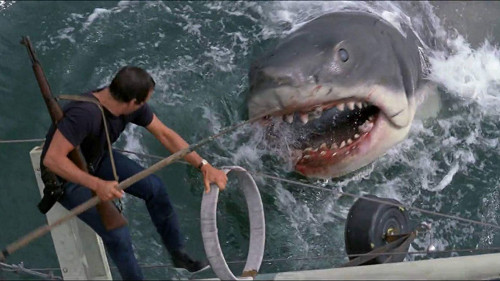 It is often said that “necessity is the mother of
invention,” and nowhere is that more evident than in Jaws. For much of
the first hour, the shark is seen only in fleeting, indistinct glimpses. Even
after its harrowing first appearance, Spielberg’s camera avoids lingering on
the creature. Only in the final fifteen minutes—when it crashes onto the deck
of the Orca and snaps at the protagonists—do we get an extended look. And from
those scenes, it becomes clear why the shark is shown so sparingly: it looks fake.
Were the film not already gripping us so completely by this point, the sight of
the rubbery animatronic might have provoked laughter instead of terror.
It is often said that “necessity is the mother of
invention,” and nowhere is that more evident than in Jaws. For much of
the first hour, the shark is seen only in fleeting, indistinct glimpses. Even
after its harrowing first appearance, Spielberg’s camera avoids lingering on
the creature. Only in the final fifteen minutes—when it crashes onto the deck
of the Orca and snaps at the protagonists—do we get an extended look. And from
those scenes, it becomes clear why the shark is shown so sparingly: it looks fake.
Were the film not already gripping us so completely by this point, the sight of
the rubbery animatronic might have provoked laughter instead of terror.
Spielberg freely admits that if the technology had been better—and if the mechanical shark had worked the way it was supposed to—he would have shown it earlier and more often. Ironically, it was this very handicap that gave the film one of its greatest strengths: by keeping the shark out of sight, the movie builds suspense to a fever pitch. Plenty of directors after Spielberg have tried this “less is more” trick in monster movies, but few have pulled it off as brilliantly.
In broad strokes, Jaws follows the novel that inspired it, though Spielberg downplays certain elements in favor of suspense and action. Peter Benchley, author of the book, also penned the original screenplay treatment—earning him co-credit on the final script—which was later reworked and polished by Carl Gottlieb and a handful of uncredited contributors (among them John Milius). Benchley even pops up on screen in a brief cameo as a TV reporter.
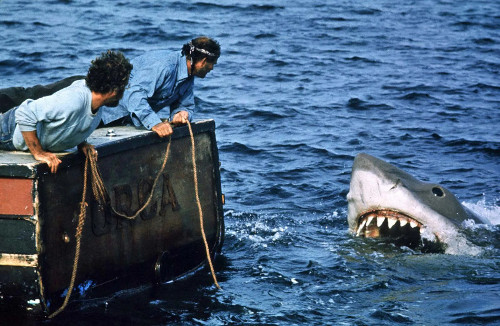 Jaws introduces us to Martin Brody (Roy Scheider),
the police chief of the small resort town of Amity. Brody has moved there to
escape the headaches of New York City, but adjusting to a slower pace proves
harder than expected. That calm is shattered about a week before July 4, when
the mutilated body of a young swimmer washes ashore. The coroner rules it a
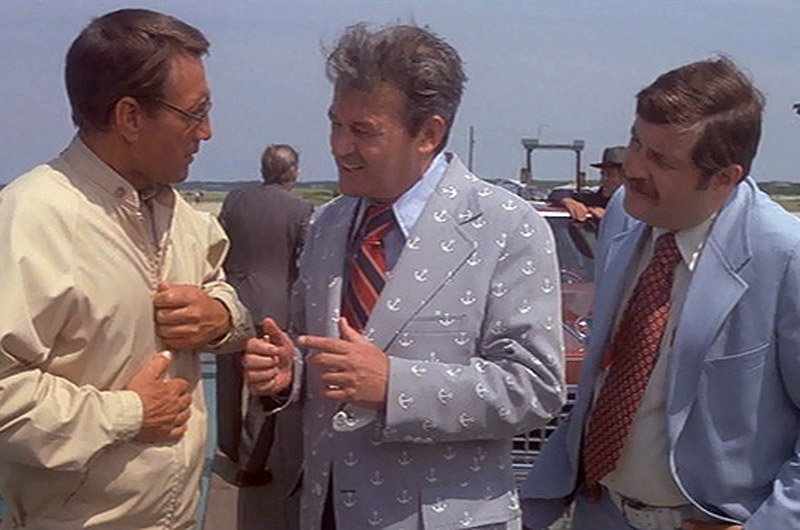
shark attack. When the mayor (Murray Hamilton) and the town council refuse to
let Brody close the beaches, he calls in help from the mainland and gets Matt Hooper
(Richard Dreyfuss), a marine biologist who seems to know everything there is to
know about sharks.
Jaws introduces us to Martin Brody (Roy Scheider),
the police chief of the small resort town of Amity. Brody has moved there to
escape the headaches of New York City, but adjusting to a slower pace proves
harder than expected. That calm is shattered about a week before July 4, when
the mutilated body of a young swimmer washes ashore. The coroner rules it a
shark attack. When the mayor (Murray Hamilton) and the town council refuse to
let Brody close the beaches, he calls in help from the mainland and gets Matt Hooper
(Richard Dreyfuss), a marine biologist who seems to know everything there is to
know about sharks.
After several more deaths, even the mayor has to admit the obvious: the shark has to go. Enter Quint (Robert Shaw), a grizzled fisherman who offers to rid Amity of its nautical nightmare—for $10,000. With Brody and Hooper aboard, he sets out to sea, straight into a life-and-death battle with a creature unlike any he’s ever faced. For Hooper, it’s a chance to study a great white up close. For Brody, it means confronting—and overcoming—his deep fear of the water.
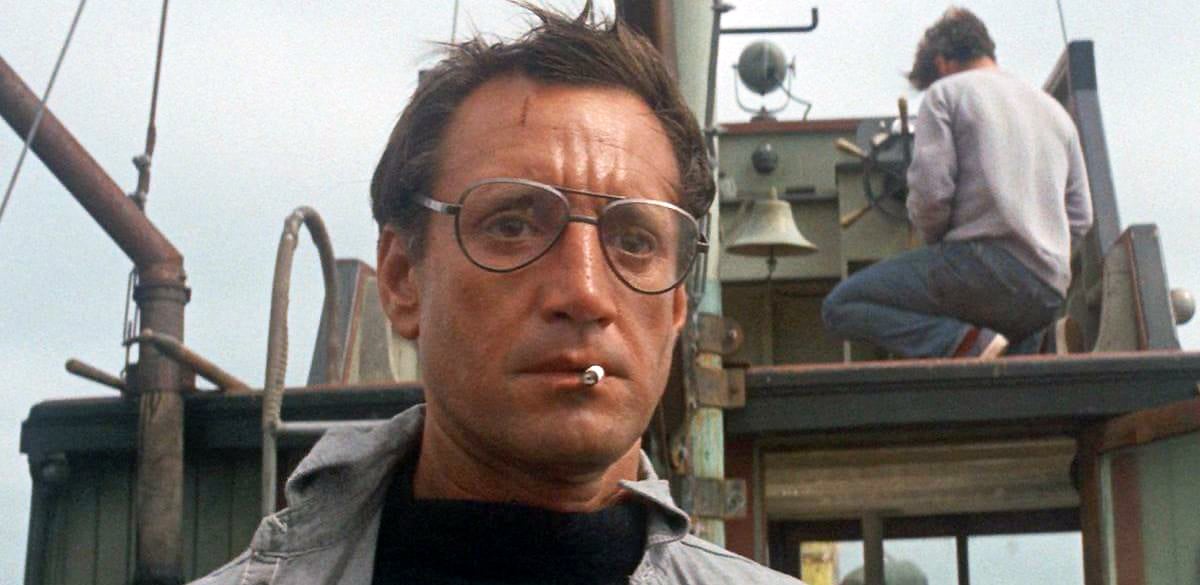 Because the true “star” of Jaws is the shark,
Spielberg wasn’t pressured to cast a big-name actor in the lead. That gave him
the freedom to choose someone who simply fit the role. Roy Scheider—at the
height of his career in the mid-to-late 1970s—grounds Martin Brody with a
relatable humanity; he feels like a real person, which makes him easy to root
for. Richard Dreyfuss, not yet a star, gives Matt Hooper charm, energy, and a
sly wit. Robert Shaw, who wasn’t Spielberg’s first choice for Quint (Lee Marvin
turned the role down), makes the character larger-than-life—a mix of Captain
Ahab and Popeye the Sailor Man. Rounding out the cast, Lorraine Gary provides
warmth as Brody’s supportive wife, and Murray Hamilton nails oily politician
Larry Vaughn, the mayor of Amity.
Because the true “star” of Jaws is the shark,
Spielberg wasn’t pressured to cast a big-name actor in the lead. That gave him
the freedom to choose someone who simply fit the role. Roy Scheider—at the
height of his career in the mid-to-late 1970s—grounds Martin Brody with a
relatable humanity; he feels like a real person, which makes him easy to root
for. Richard Dreyfuss, not yet a star, gives Matt Hooper charm, energy, and a
sly wit. Robert Shaw, who wasn’t Spielberg’s first choice for Quint (Lee Marvin
turned the role down), makes the character larger-than-life—a mix of Captain
Ahab and Popeye the Sailor Man. Rounding out the cast, Lorraine Gary provides
warmth as Brody’s supportive wife, and Murray Hamilton nails oily politician
Larry Vaughn, the mayor of Amity.
 Jaws really has two villains. In the first half, the
enemy isn’t the shark at all—it’s bureaucracy, embodied by Mayor Vaughn. More
worried about the town’s summer profits than public safety, Vaughn silences
Brody, and the result is more blood in the water. While Brody wrestles with
Vaughn and his council cronies, the shark waits in the wings, ready to assume
the role of true antagonist once the mayor finally gives way. The second half
shifts gears into a classic man-versus-beast struggle, with Jaws standing in as
one of cinema’s rarest monsters: a real creature from the depths of the ocean
(just usually not quite so large). This, of course, is the showdown audiences
come to see—and Spielberg stages it with masterful skill.
Jaws really has two villains. In the first half, the
enemy isn’t the shark at all—it’s bureaucracy, embodied by Mayor Vaughn. More
worried about the town’s summer profits than public safety, Vaughn silences
Brody, and the result is more blood in the water. While Brody wrestles with
Vaughn and his council cronies, the shark waits in the wings, ready to assume
the role of true antagonist once the mayor finally gives way. The second half
shifts gears into a classic man-versus-beast struggle, with Jaws standing in as
one of cinema’s rarest monsters: a real creature from the depths of the ocean
(just usually not quite so large). This, of course, is the showdown audiences
come to see—and Spielberg stages it with masterful skill.
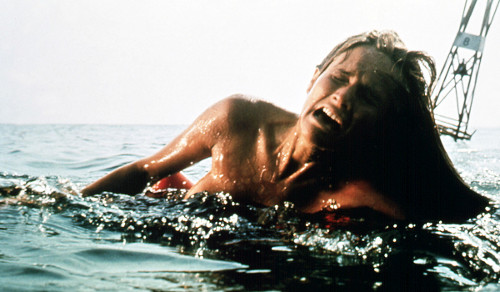
Much of Jaws is an exercise in ratcheting up tension. Take the scene when the little boy is killed: Spielberg gives us a whole lineup of potential victims, cutting to the “shark’s-eye” view as Brody watches nervously from the beach, certain something awful is about to happen. The sequence is filled with red herrings, priming us—along with Brody—for tragedy. Spielberg pulls the same trick in each of the attack scenes, starting with the very first, when a skinny-dipper is mauled, thrashed about, and finally dragged under.
 The movie’s most memorable moment comes when Brody gets his
first real look at his nautical nemesis. After casually tossing a few dead fish
overboard, he turns his back for a second—then looks up straight into the
gaping maw of the shark. Staggering backward into the cabin, he delivers Jaws’
most famous line: “You’re gonna need a bigger boat.” It’s a perfect example of
Spielberg lacing the terror with a dose of dark humor. (The line was actually
an ad-lib.)
The movie’s most memorable moment comes when Brody gets his
first real look at his nautical nemesis. After casually tossing a few dead fish
overboard, he turns his back for a second—then looks up straight into the
gaping maw of the shark. Staggering backward into the cabin, he delivers Jaws’
most famous line: “You’re gonna need a bigger boat.” It’s a perfect example of
Spielberg lacing the terror with a dose of dark humor. (The line was actually
an ad-lib.)
The music for Jaws may not be John Williams’ most elaborate or rousing score, but its shark theme—endlessly spoofed and instantly recognizable—has become one of the most iconic cues in film history. The reason is simple: it works. Paired with the “shark’s-eye” camera shots, Williams’ ominous notes signal the creature’s approach, even when it never appears on screen.
The massive success of Jaws spawned three inferior sequels, each one worse than the last. It also inspired a wave of imitators, from Dino De Laurentiis’ dreadful Orca: The Killer Whale to the more enjoyable Deep Blue Sea—which boasted realistic sharks but nowhere near the same suspense. Still, the original stands alone. When it comes to this kind of thriller, no film has ever topped Jaws, and with each passing year it feels even less likely that anything will.
Jaws (United States, 1975)
Cast: Roy Scheider, Richard Dreyfuss, Robert Shaw, Lorraine Gary, Murray Hamilton
Screenplay: Peter Benchley and Carl Gottlieb, based on the novel by Benchley
Cinematography: Bill Butler
Music: John Williams
U.S. Distributor: Universal Pictures
U.S. Release Date: 2025-08-29
MPAA Rating: "PG" (Violence, Gore, Nudity)
Genre: Thriller
Subtitles: none
Theatrical Aspect Ratio: 1.85:1
- Punisher, The (2004)
- (There are no more worst movies of Roy Scheider)
- (There are no more worst movies of Robert Shaw)
Comments