Klara and the Sun (United States, 2026)
October 25, 2026
There are some books that shouldn't be made into movies. Many of them, actually. But the film industry is so desperate for content that such concerns are often ignored. Case in point: Klara and the Sun. The original novel, written by Kazuo Ishiguro (the Nobel Prize-winning author who brought us The Remains of the Day), is a beloved dystopian tale whose first-person perspective and precise prose make it almost impossible to translate. (Maybe Charlie Kaufman could have attempted something at the height of his powers.) In adapting it, writer/director Taika Waititi and co-writer Dahvi Waller have remained largely faithful to the narrative, retaining many of the beats and doing their best to adopt a first-person approach, but they have somehow managed to lose the soul of the book.
The biggest problem lies in the push-pull between art and commercialization. The novel Klara and the Sun is not a mainstream page-turner. It's introspective and thought-provoking, but the actual storyline is somewhat limited. In bringing the plot to the screen, Waititi has attempted to speed things up, streamline the trajectory, and make the pacing more film-friendly. All of these choices pull the movie version further from what's best about the book. The attempts to inject comedy feel disjointed, and the altered ending, which introduces the concept of an unreliable narrator, replaces closure with ambiguity. The film also largely fails when it comes to world-building; its futuristic landscape is never explored in a full or satisfactory way. And, when it comes to one of today's big hot-buttons, Artificial Intelligence and robot sentience, that film has almost nothing of interest to offer. It's a plot device that gets minimal exploration. No Ex Machina here.
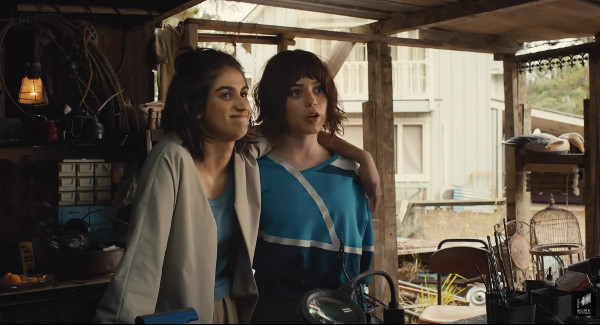 The best thing about Klara and the Sun is Jenna
Ortega, whose interpretation of the title character invokes a Pinocchio-esque
sense of wonder and awkwardness. No one else leaves much of an impression, and
Amy Adams' phoned-in portrayal is especially disappointing considering how good
an actor she normally is. As Klara's human friend, Josie, Mia Tharia feels
short-changed, with some of the character's rough edges having been sanded
down, although she and Ortega evince an effective chemistry.
The movie starts strongly. Some of the early scenes, which sketch out the setup, are among its best. We are introduced to Klara, an outdated model Artificial Friend who lives in a store managed by the Shopkeeper (Natasha Lyonne) and dreams of being sold. (Anyone read Corduroy by Don Freeman?) She prays daily to the sun, whom she has chosen as her deity. Then, one day, along comes Josie, a "lifted" girl (whose DNA has been genetically engineered to make her smarter and more talented) in need of a companion. Her mother, Chrissie (Adams), reluctantly purchases Klara, and the rest of the movie chronicles the robot's interactions with Josie and the others around her at the isolated rural house where they live.
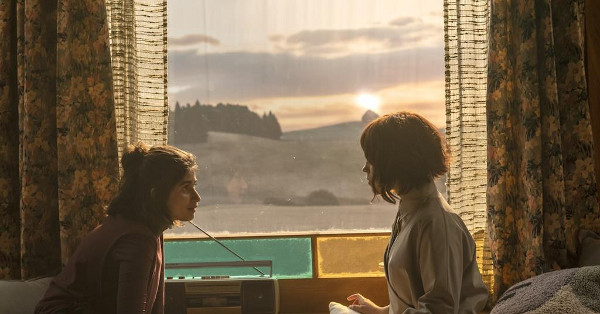 Waititi's limited first-person approach ensures that no
scene transpires in which Klara is not present and aware. He occasionally
presents the world directly through her eyes, complete with pixelation when
appropriate. Although I can understand what he's trying to do with this, I
can't say it really works because it feels like a gimmick and is more likely to
distance the viewer than draw them deeper into Klara's reality. The overall
technique also leads to a possibly intentional muddying of the ending, where it
becomes unclear to what degree Klara's "reality" has been
compromised.
It's not always a bad thing for a movie to make significant changes to a source novel. When considering the differences between print and screen, I often think of Children of Men, the P.D. James tale that Alfonso Cuarón used as a loose inspiration for his film of the same name. Both are very good in their own right, although the connective tissue is tenuous. The problem with Klara and the Sun is that Waititi wants to adapt rather than create. He tries to retain as much of the source material as possible when doing so is inherently non-cinematic. The result is uneven at best and rarely engaging or involving. Tonal whiplash occurs with frequency, and the ending feels fundamentally unsatisfying. Klara and the Sun deserves to be experienced, but not in this screen version.
Klara and the Sun (United States, 2026)
Cast: Jenna Ortega, Amy Adams, Mia Tharia, Aran Murphy, Steve Buscemi, Natasha Lyonne
Screenplay: Taika Waititi and Dahvi Waller, based on the novel by Kazuo Ishiguro
Cinematography: Mike Berlucchi
Music: Michael Giacchino
U.S. Distributor: Columbia Pictures
U.S. Release Date: 2026-10-23
MPAA Rating: "PG-13" (Thematic elements, some violence and strong language)
Genre: Science Fiction/Drama
Subtitles: none
Theatrical Aspect Ratio: 2.39:1
- (There are no more better movies of Mia Tharia)
- (There are no more worst movies of Mia Tharia)
Comments