Fjord (Romania/Norway/Sweden, 2026)
November 05, 2026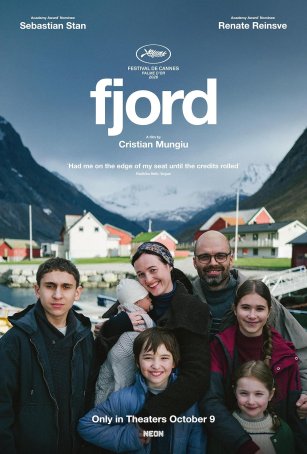
There's a lot to like about Fjord, the 2026 Cannes Film Festival Palme d'Or winner, but two qualities keep the production from reaching the upper echelon of foreign imports. An "issues movie," the film fails to avoid the trap of occasional preachiness. This shortcoming is most evident during the court proceedings, when the attorneys' speeches make it all too clear which message writer/director Cristian Mungiu (4 Months, 3 Weeks and 2 Days) espouses. Even more problematic is the flimsy development of a key relationship whose unexplained intensity is mandated by the narrative but never fully justified.
That being said, this is still a compelling drama. On the surface, it might seem to be an examination of the validity of corporal punishment as a form of discipline, but in a way, that's a red herring. The real subject of Mungiu's thesis is governmental overreach. His approach to the thorny issue of using physical force in child-rearing ("spare the rod, spoil the child") is balanced, favoring neither the accepted stance of the state nor that of the parents, while presenting coherent cases for both sides. What emerges as the central conflict, however, is how Norway enforces its policies. Fjord doesn't deny the validity of the government's position; it attacks the methods used to uphold it. That's where the preachiness comes in – both via lawyers giving impassioned pleas in court and by making the child welfare officials come across as one-dimensional villains.
Loosely inspired by the real-life 2015 Bodnariu family separation case, Fjord opens with Mihai Gheorghiu (Sebastian Stan), a devout Romanian Christian, and his Norwegian wife, Lisbet (Renate Reinsve), relocating from Romania with their five children to a remote, insular coastal village in Western Norway. The family moves in next door to the local school principal, Mats (Markus Tønseth), his Swedish wife, Mia (Lisa Carlehed), and their rebellious teenage daughter, Noora (Henrikke Lund-Olsen). A bond forms between Noora and the Gheorghius' two oldest children, Elia (Vanessa Ceban) and Emmanuel (Jonathan Ciprian Breazu) – something that concerns the adults of both families. Mats is skeptical of the religious routines and strict discipline of his new neighbors, while Mihai is worried about his children straying. The quiet tension comes to a head when a teacher notices bruises on Elia's back and she admits to occasional spankings when questioned by school officials. This prompts the intervention of Norway's Child Welfare Services, which immediately separates all five children, including a baby who is still nursing, from their parents. Mihai and Lisbet quickly discover that they have little recourse to regain custody of their children.
 The central drama is strongly presented. Fjord is
careful never to clearly state whether any abuse took place. We are not privy
to the actual punishments, nor do we see how Elia received the visible bruises.
Mungiu avoids stacking the deck here – he neither condemns the Gheorghius' use
of mild physical chastisement (typically spanking the bottom with an open
palm), which is a cultural norm for the family, nor does he misrepresent the
reasons for the government's concern. Instead, he focuses on the damage done to
the family as the parents navigate a bureaucratic web established by Child
Welfare Services that seems designed to keep Mihai and Lisbet from regaining
custody.
One area where the film could benefit from opening up the narrative relates to the relationship between Noora and Elia (and, to a lesser extent, Emmanuel). Although their connection is broadly sketched out across several scenes, the intensity of Noora's dismay (and her subsequent actions) feels poorly justified. The exact nature of the bond is never fully explored, although an unspoken romantic attraction might be a possible explanation. Regardless, this is one aspect in which the script is lacking.
 The photography is, not surprisingly, striking.
Cinematographer Tudor Vladimir Panduru uses the towering fjord walls to
transform the location into a believable, claustrophobic setting. The acting
from the leads is equally strong, with Sebastian Stan looking nothing like he
does when playing Bucky Barnes, the role for which he is best known. This also
represents a reunion for him and Renate Reinsve; the two were a romantic pair
in A Different Man. As good as these two are, there are some issues with
the supporting players, especially those portraying government and school
officials. The tendency with those performances is to be dour and
one-dimensional, with little evidence of anything even remotely resembling
empathy.
Overall, Fjord has the kind of thrust one expects from any movie that depicts moral outrage. Operating in his signature clinical style – relying on long, unbroken takes and eschewing a manipulative musical score – Mungiu lets the story play out. Even at nearly two and a half hours, the deliberate pacing rarely flags because the stakes feel so immediate. Despite its narrative blind spots, Fjord remains a haunting procedural that engages on both an emotional and intellectual level.
Fjord (Romania/Norway/Sweden, 2026)
Cast: Sebastian Stan, Renate Reinsve, Lisa Carlehed, Henrikke Lund-Olsen, Vanessa Ceban, Jonathan Ciprian Breazu
Screenplay: Cristian Mungiu
Cinematography: Tudor Vladimir Panduru
Music: Kaspar Kaae
U.S. Distributor: NEON
U.S. Release Date: 2026-10-09
MPAA Rating: "R" (Language, nudity, and self-injury)
Genre: Drama
Subtitles: English, Norwegian, and Romanian with subtitlesnone
Theatrical Aspect Ratio: 2.39:1
- Sentimental Value (2025)
- Backrooms (2026)
- (There are no more better movies of Renate Reinsve)
- (There are no more worst movies of Renate Reinsve)
- Tunnel, The (2021)
- (There are no more better movies of Lisa Carlehed)
- (There are no more worst movies of Lisa Carlehed)
Comments