Forgotten Island (United States, 2026)
September 25, 2026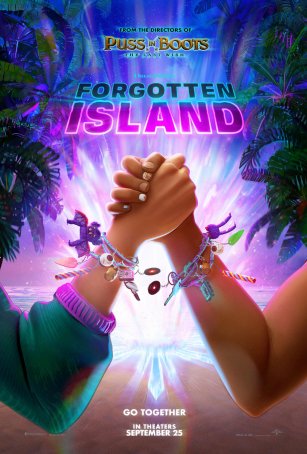
Forgotten Island is a fever dream of an animated movie—Miyazaki on acid with aesthetic elements borrowed from Puss in Boots: The Last Wish (the previous feature directed by Joel Crawford and Januel Mercado) and the Spider-Verse films. With a "hard PG" rating, the film doesn't kowtow to the youngest segment of the family demographic. It is sometimes violent and scary, and features a bit more light profanity ("pisses," "damn") than one normally finds in mainstream animated fare. Across a landscape of cookie-cutter big-screen cartoons, this entry has a welcome edginess that functions as more than just a sleep deterrent for parents. The characters are well-realized, the narrative includes genuine unpredictability, and the animation is invigorating. The only caveat is that the overly neat ending isn't fully earned.
The movie functions as a love letter to the Philippines. Both directors have a connection to the Pacific island nation: Mercado frequently spent summer vacations there as a child, and Crawford's wife is Filipina. The storyline opens in the Philippines, draws heavily on local folklore and mysticism, and features numerous voice actors with Filipino heritage (H.E.R., Liza Soberano, Lea Salonga, Manny Jacinto, Dolly de Leon, and Jo Koy). The movie doesn't merely name-check or throw in a couple of Easter eggs from the region; it weaves the geography and culture deeply into its very DNA.
 Set in the pre-cellphone 1990s, Forgotten Island focuses
on two best friends, Jo (H.E.R.) and Raissa (Liza Soberano), who find
themselves facing an impending separation as Raissa prepares to travel to the
United States for college. On their last night together, Jo accidentally
triggers a mystical sand dollar that opens a portal to the enchanted island of
Nakali, where they encounter creatures straight out of folklore and dreams.
They soon find themselves allied with the likes of Raww (Dave Franco), a
shapeshifting were-dog; Bungi (Manny Jacinto), a giant demon baby; and Prince
Mermahn of the Kataw people (Kevin McCann). Their attempts to return home
eventually bring them into conflict with the memory-stealing entity Batiba
(Jenny Slate) and the fearsome Manang (Lea Salonga).
Set in the pre-cellphone 1990s, Forgotten Island focuses
on two best friends, Jo (H.E.R.) and Raissa (Liza Soberano), who find
themselves facing an impending separation as Raissa prepares to travel to the
United States for college. On their last night together, Jo accidentally
triggers a mystical sand dollar that opens a portal to the enchanted island of
Nakali, where they encounter creatures straight out of folklore and dreams.
They soon find themselves allied with the likes of Raww (Dave Franco), a
shapeshifting were-dog; Bungi (Manny Jacinto), a giant demon baby; and Prince
Mermahn of the Kataw people (Kevin McCann). Their attempts to return home
eventually bring them into conflict with the memory-stealing entity Batiba
(Jenny Slate) and the fearsome Manang (Lea Salonga).
Similarities to Spirited Away are probably not coincidental, as most animated filmmakers today genuflect at the Miyazaki altar. The concept of stripping away memories and identity is central to both the 2001 classic and Forgotten Island, and the directors utilize Filipino folklore in much the same way Miyazaki leveraged Japanese animism. There are other obvious commonalities as well, including a deep reverence for nature and a focus on misunderstood "monsters." Forgotten Island's distinct cultural identity prevents it from feeling like a mere Miyazaki knock-off, but the homages in both style and substance are undeniable.
 Friendship lies at the core of Forgotten Island,
anchoring a narrative about the enduring power of the love these two young
women share. The degree to which this could be viewed as a coded lesbian story
is debatable. The only thing explicitly provided by the text is that Jo and
Raissa are inseparable, having been so since they met as young children. The
true depth of their closeness remains unspoken, allowing it to be interpreted
as anything from a fierce platonic bond to something... more. This ambiguity is
likely intentional, at least for practical reasons. Forgotten Island is
not some small indie designed to headline queer film festivals; it is a
mainstream DreamWorks release that the studio does not want banned from
territories with anti-LGBTQ+ biases. Consequently, the most practical approach
is to allow individual viewers to fill in the blanks.
Friendship lies at the core of Forgotten Island,
anchoring a narrative about the enduring power of the love these two young
women share. The degree to which this could be viewed as a coded lesbian story
is debatable. The only thing explicitly provided by the text is that Jo and
Raissa are inseparable, having been so since they met as young children. The
true depth of their closeness remains unspoken, allowing it to be interpreted
as anything from a fierce platonic bond to something... more. This ambiguity is
likely intentional, at least for practical reasons. Forgotten Island is
not some small indie designed to headline queer film festivals; it is a
mainstream DreamWorks release that the studio does not want banned from
territories with anti-LGBTQ+ biases. Consequently, the most practical approach
is to allow individual viewers to fill in the blanks.
Visually, the animation isn't trying to compete with the pristine gloss of the latest Pixar offering. That isn't to say it's ugly—quite the contrary, in fact. The palette, however, hews toward the neon side of the color wheel, and the imagery frequently abandons pure 3D CGI. 2D animation regularly intrudes, largely during subjective flashbacks and in moments requiring distinct emotional emphasis. A barrage of flash-cutting and psychedelic inserts keeps the aesthetic constantly dynamic. "Standard" simply doesn't apply here, and that works entirely to the film's benefit.
 The only thing preventing Forgotten Island from
becoming an instant classic is that its ending is... well... disappointing.
Younger viewers probably won't mind—hell, maybe even some older viewers won't
either. But for this specific resolution to happen, several unearned plot
contrivances come into play. It is a sheer deus ex machina twisting of
the narrative. I was left frustrated not so much by where the characters ended
up, but by how they got there. Coherent internal storytelling matters, and that
is precisely where Forgotten Island drops the ball during its final
fifteen minutes.
The only thing preventing Forgotten Island from
becoming an instant classic is that its ending is... well... disappointing.
Younger viewers probably won't mind—hell, maybe even some older viewers won't
either. But for this specific resolution to happen, several unearned plot
contrivances come into play. It is a sheer deus ex machina twisting of
the narrative. I was left frustrated not so much by where the characters ended
up, but by how they got there. Coherent internal storytelling matters, and that
is precisely where Forgotten Island drops the ball during its final
fifteen minutes.
Still, this is as energetic and original an animated film as we have seen this year, easily trumping the more conventional Toy Story 5 and Minions & Monsters. It feels more like the expression of a distinct artistic vision than another building block in a corporate foundation. DreamWorks has largely surpassed Pixar in terms of making the most creatively interesting mainstream animated features today, and this is just another example. While not perfect, it is a massive improvement over the sterile sameness that has become all too commonplace throughout the industry.
Forgotten Island (United States, 2026)
Cast: H.E.R., Liza Soberano, Dave Franco, Manny Jacinto, Jenny Slate, Lea Salonga, Dolly De Leon, Jo Koy, Kevin McCann
Screenplay: Joel Crawford, Januel Mercado
Cinematography: Dirk Van Dulmen
Music: Nathan Matthew David
U.S. Distributor: Focus Features
U.S. Release Date: 2026-09-25
MPAA Rating: "PG" (For animated sequences of scary action, language, rude humor)
Genre: Animated/Fantasy
Subtitles: none
Theatrical Aspect Ratio: 2.39:1
- (There are no more better movies of H.E.R.)
- (There are no more worst movies of H.E.R.)
- (There are no more better movies of Liza Soberano)
- Lisa Frankenstein (2024)
- (There are no more worst movies of Liza Soberano)
Comments