Wuthering Heights (United Kingdom/United States, 2026)
February 13, 2026
Emerald Fennell’s Wuthering Heights opens with a promise the rest of the film is ultimately unable to keep. It begins with the spectacle of a mid-19th-century public hanging—an event that conflates death with lust, instantly drawing the viewer into a stylized vision of the world in which Emily Brontë's lone novel unfolds. By Fennell’s own admission, this is less a faithful adaptation of the 1847 classic and more a "re-imagination." Alas, whatever provocative goals Fennell may have harbored for her follow-up to Saltburn get lost in translation. What remains is an overwrought period romance, complete with smoldering gazes and heaving bosoms; the brief BDSM interludes feel like mere icing on a remarkably bland cake.
Brontë purists are already up in arms over Fennell’s deviations from the source text, but she is hardly the first director to dampen the novel's supernatural elements or excise the second-generation subplot. To keep the runtime manageable, Fennell focuses strictly on the doomed affair between Cathy (Margot Robbie) and Heathcliff (Jacob Elordi).
Unfortunately, as dramatized here, this relationship isn't enough to sustain a 135-minute feature. While the film looks gorgeous—employing a deliberate "female gaze" accompanied by a throbbing, humming score by Anthony Willis—the central performances are too restrained. There is a palpable lack of chemistry between Robbie and Elordi. The film never allows their bond to reach the unhinged, "off-the-wall" quality seen in a singular, standout scene between Heathcliff and his wife, Isabella (Alison Oliver). Frankly, the "suffocating passion" is a bore; the characters are not only unlikeable but, more damningly, they simply don't mesh.
The script cherry-picks elements from the novel—just enough to justify the "based on" credit, but not enough to suggest a lived-in world. We begin with the aforementioned hanging, attended by a young Cathy (Charlotte Mellington) and her companion, Nelly (Vy Nguyen as a youth; Hong Chau as an adult). They live under the thumb of Cathy’s father (Martin Clunes), an alcoholic gambler seemingly intent on making Wuthering Heights the gloomiest estate on earth. When he brings home a homeless boy (Owen Cooper) to be Cathy’s friend, she names him Heathcliff and they become inseparable. He proves his devotion by enduring a vicious beating, and a lifelong bond is forged.
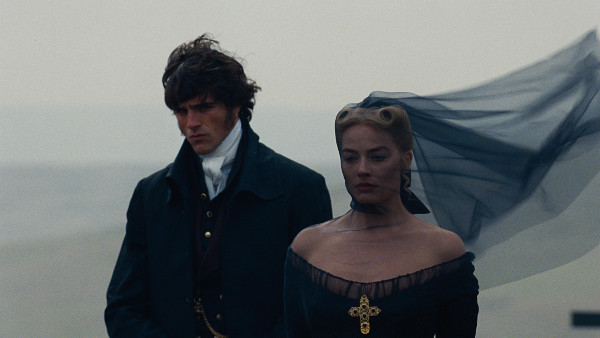 When the film skips ahead to their adulthood, the misery has
only intensified. With the Earnshaw fortune depleted, the house is in disarray
and the fireplaces are cold. Seeking an escape from the squalor, Cathy seduces
her wealthy neighbor, Edgar Linton (Shazad Latif). Viewing this as the ultimate
betrayal, Heathcliff vanishes, leaving Cathy bereft. She moves on to a life of
comfortable misery—until the day her girlhood love returns, radically changed
and carrying a dark, vengeful undercurrent.
When the film skips ahead to their adulthood, the misery has
only intensified. With the Earnshaw fortune depleted, the house is in disarray
and the fireplaces are cold. Seeking an escape from the squalor, Cathy seduces
her wealthy neighbor, Edgar Linton (Shazad Latif). Viewing this as the ultimate
betrayal, Heathcliff vanishes, leaving Cathy bereft. She moves on to a life of
comfortable misery—until the day her girlhood love returns, radically changed
and carrying a dark, vengeful undercurrent.
After the hedonistic opening, Fennell opts for an odd sort of restraint. Outside of some tame B&D aesthetics, there is little salaciousness to be found. It is particularly disappointing to see a director known for pushing envelopes avoid anything truly shocking. A scene where Heathcliff spies on Cathy masturbating, for instance, barely registers on the erotic Richter scale; she is merely embarrassed, and he is vaguely amused. Their actual love scenes reach for a heat that never materializes. Even the anachronistic songs—including several Charli XCX tracks—feel like a distraction rather than a stylistic choice that adds flavor.
 Margot Robbie’s performance is best described as adequate.
While she looks striking against the bleak moors, there isn't a single scene
that could be deemed memorable. This won't sit alongside The Wolf of Wall
Street or Barbie as a career-defining turn. Jacob Elordi, who was so
effective in Saltburn, proves he is good at brooding, but his Heathcliff
feels more like an avatar than a character. The most notable work actually
comes from Alison Oliver, whose Isabella is a deliciously ambiguous cauldron of
contradictions.
Margot Robbie’s performance is best described as adequate.
While she looks striking against the bleak moors, there isn't a single scene
that could be deemed memorable. This won't sit alongside The Wolf of Wall
Street or Barbie as a career-defining turn. Jacob Elordi, who was so
effective in Saltburn, proves he is good at brooding, but his Heathcliff
feels more like an avatar than a character. The most notable work actually
comes from Alison Oliver, whose Isabella is a deliciously ambiguous cauldron of
contradictions.
Adapting a classic novel of tragic romance is a notoriously difficult task—Anna Karenina being the poster child for repeated failures. Fennell is wandering in familiar territory here; hardly a decade goes by without a new Wuthering Heights, yet the gold standard remains the 1939 version with Laurence Olivier and Merle Oberon (which, to be frank, isn't even that good). Fennell’s attempts to "spice up" the story feel half-hearted, and the central relationship never gels. If the mandate for any new interpretation is to offer something fresh, one is left wondering what this version claims as its justification for taking up over two hours of our time.
Wuthering Heights (United Kingdom/United States, 2026)
Cast: Margot Robbie, Jacob Elordi, Hong Chau, Shazad Latif, Alison Oliver, Martin Clunes
Screenplay: Emerald Fennell, based on the novel by Emily Bronte
Cinematography: Linus Sandgren
Music: Anthony Willis
U.S. Distributor: Warner Brothers
U.S. Release Date: 2026-02-13
MPAA Rating: "R" (Sexual Content, Violence, Adult Themes including BDSM and a depiction of a hanging)
Genre: Drama/Romance
Subtitles: none
Theatrical Aspect Ratio: 1.85:1
- Saltburn (2023)
- Frankenstein (2025) (2025)
- (There are no more better movies of Jacob Elordi)
- Priscilla (2023)
- (There are no more worst movies of Jacob Elordi)
- Menu, The (2022)
- Kinds of Kindness (2024)
- (There are no more better movies of Hong Chau)
- Whale, The (2022)
- Downsizing (2017)
- (There are no more worst movies of Hong Chau)
Comments