Avatar: Fire and Ash (United States, 2025)
December 17, 2025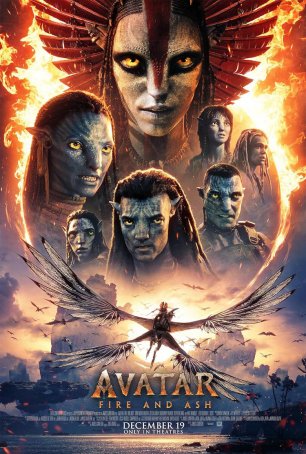
The build-up for Avatar: Fire and Ash wasn’t quite as intense as the one between the original Avatar and its first sequel, Avatar: The Way of Water, due in large part to the shorter span between releases (three years versus thirteen). As was true of the earlier films, director James Cameron continues to push the technological envelope, although there’s a sense he’s running up against a wall that may not be breachable without a major leap forward in 3-D (such as a no-glasses version). Fire and Ash is an experience unlike anything else released this year: immersive, exciting, and visually stunning. However, although narrative has always taken a back seat in these films, the storytelling limitations are a little more evident this time. A sense of repetition is hard to avoid. Cameron moves things forward and continues his impressive world-building, but certain scenes echo moments from the earlier entries (especially The Way of Water).
In an era when many filmmakers are pulling back on blockbuster ambitions, Cameron makes no such concessions. And when bloated budgets have paradoxically given way to cheaper-looking visual effects, the Avatar films remain the exception. With a reported production budget of about $250 million, this is one of the most expensive films ever made, yet it still trails the likes of Jurassic World: Dominion and Snow White on the 2025 roster—and looks orders of magnitude better. With Cameron’s films, the money is on the screen, not lining someone’s pockets. If the goal is awe, Cameron achieves it.
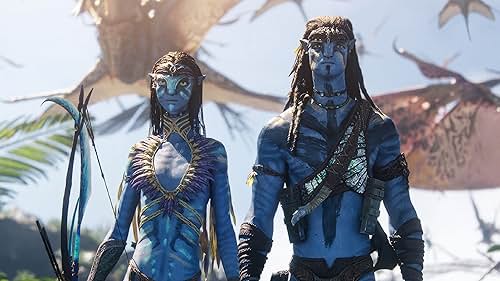 The third film opens not long after the second, with Jake
(Sam Worthington) and Neytiri (Zoë Saldaña) mourning the death of their eldest
son, Neteyam. Neteyam’s siblings—brother Lo’ak (Britain Dalton), stepbrother
Spider (Jack Champion), sister Tuk (Trinity Jo-Li Bliss), and stepsister Kiri
(Sigourney Weaver)—are wrestling with their own emotional struggles, with Lo’ak
blaming himself for the tragedy. Meanwhile, the Metkayina clan finds itself
threatened by a new Na’vi tribe, the Ash People, whose leader Varang (Oona
Chaplin) has formed an alliance with Quaritch (Stephen Lang) and his “Sky
People.” Quaritch continues to pursue his vendetta against Jake while
attempting to reunite with—or recapture—his son, Spider, who has thrown his
allegiance behind his adopted family.
The third film opens not long after the second, with Jake
(Sam Worthington) and Neytiri (Zoë Saldaña) mourning the death of their eldest
son, Neteyam. Neteyam’s siblings—brother Lo’ak (Britain Dalton), stepbrother
Spider (Jack Champion), sister Tuk (Trinity Jo-Li Bliss), and stepsister Kiri
(Sigourney Weaver)—are wrestling with their own emotional struggles, with Lo’ak
blaming himself for the tragedy. Meanwhile, the Metkayina clan finds itself
threatened by a new Na’vi tribe, the Ash People, whose leader Varang (Oona
Chaplin) has formed an alliance with Quaritch (Stephen Lang) and his “Sky
People.” Quaritch continues to pursue his vendetta against Jake while
attempting to reunite with—or recapture—his son, Spider, who has thrown his
allegiance behind his adopted family.
Although the non-credits running time of Fire and Ash crosses the three-hour mark, there’s surprisingly little bloat. The story unfolds smoothly, with Cameron interleaving quiet character beats with bravura action sequences that burst off the screen and fill the theater. The climactic battle, as one might reasonably expect, is the year’s most astonishing spectacle, although one could argue that there’s almost too much going on to track everything. In a way, some of the more intimate moments stand out even more—a tense interaction between Jake and Spider, or a charged father-son conversation between Quaritch and Spider. The movie also gives us one of the series’ most unlikely alliances, although it doesn’t last long (and ends with a well-timed one-liner).
Cameron’s focus on characters and world-building makes Fire and Ash a cut above similarly effects-heavy productions. No, he’s not 100% successful, but when you compare the human interaction here with something like Attack of the Clones, it’s evident how much better Cameron can write dialogue and craft relationships than many of his special-effects-minded contemporaries.
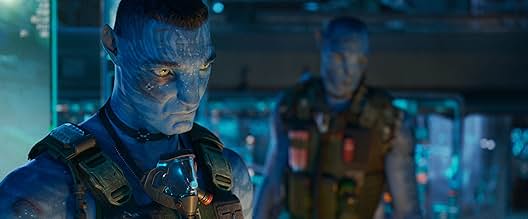 Cameron has long touted performance-capture as a way to
retain an actor’s full emotional range while transforming their physical
appearance, and he has refined this approach with each installment. It’s easy
to dismiss the work done by Sam Worthington, Zoë Saldaña, Sigourney Weaver, and
others because so much of Fire and Ash resembles animation, but these
are lived-in performances: human actors, not digital figures conjured on a
workstation. As was the case in the earlier films, Stephen Lang steals the
spotlight, and newcomer Oona Chaplin is ferocity incarnate. Talk about a power
couple.
Cameron has long touted performance-capture as a way to
retain an actor’s full emotional range while transforming their physical
appearance, and he has refined this approach with each installment. It’s easy
to dismiss the work done by Sam Worthington, Zoë Saldaña, Sigourney Weaver, and
others because so much of Fire and Ash resembles animation, but these
are lived-in performances: human actors, not digital figures conjured on a
workstation. As was the case in the earlier films, Stephen Lang steals the
spotlight, and newcomer Oona Chaplin is ferocity incarnate. Talk about a power
couple.
If Avatar: Fire and Ash proves to be the final film in the saga, it’s a worthy end. Cameron doesn’t sew up every loose thread, but he resolves enough that this could function as a conclusion. He has plans for two more installments—and has even filmed portions of Avatar 4—but his precondition for continuing is box-office success. He also has other projects he wants to pursue, so the final two entries (which would be shot back-to-back) probably won’t see the light of day this decade, if ever. Cameron is now in his seventies, and the director is notorious for pushing himself as hard—or harder—than he pushes his actors.
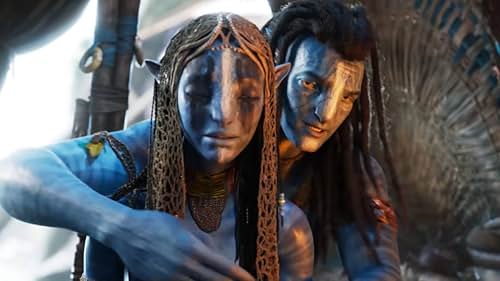 It’s worth considering whether there’s a case to see Fire
and Ash in 2-D. It ultimately comes down to physical comfort. If the
glasses are too uncomfortable or there’s an issue with how the 3-D is
perceived, this remains a strong enough experience to seek out in flat
projection. (Although the movie is primarily showing in 3-D, some 2-D options
exist.) Despite the sweeping, soaring, you-are-in-the-action qualities that
have always been among the franchise’s strongest selling points—and Cameron is
still the undisputed master of this technology—the composition is skilled
enough that the film should work in 2-D. But “big screen” is still essential.
The movie needs to come just shy of an “assault on the senses” to achieve
maximum effect.
It’s worth considering whether there’s a case to see Fire
and Ash in 2-D. It ultimately comes down to physical comfort. If the
glasses are too uncomfortable or there’s an issue with how the 3-D is
perceived, this remains a strong enough experience to seek out in flat
projection. (Although the movie is primarily showing in 3-D, some 2-D options
exist.) Despite the sweeping, soaring, you-are-in-the-action qualities that
have always been among the franchise’s strongest selling points—and Cameron is
still the undisputed master of this technology—the composition is skilled
enough that the film should work in 2-D. But “big screen” is still essential.
The movie needs to come just shy of an “assault on the senses” to achieve
maximum effect.
I don’t expect Avatar: Fire and Ash to win many converts to Cameron’s methods. As impressive as it all is, the characters are a major part of what will bring viewers back for this second sequel. By now they’re well established, and watching the sci-fi family saga of their triumphs and tragedies provides as compelling a reason to stick with the series as the eye-popping visuals and thunderous sound design. This is as good as spectacle moviemaking gets: old-fashioned in intention but fully modern in execution. It may not stand quite as high as its two predecessors, but the fall-off is neither extreme nor precipitous.
Avatar: Fire and Ash (United States, 2025)
Cast: Sam Worthington, Zoe Saldana, Sigourney Weaver, Stephen Lang, Oona Chaplin, Kate Winslet, Cliff Curtis, Edie Falco, Brendan Cowell, Britain Dalton, Trinity Jo-Li Bliss, Jack Champion, Bailey Bass, Giovanni Ribisi
Screenplay: James Cameron & Rick Jaffa & Amanda Silver
Cinematography: Russell Carpenter
Music: Simon Franglen, James Horner
U.S. Distributor: 20th Century Studios
U.S. Release Date: 2025-12-19
MPAA Rating: "PG-13" (Violence, Profanity, Brief Nudity)
Genre: Science Fiction/Adventure
Subtitles: none
Theatrical Aspect Ratio: 2.35:1
Comments