The Further Mis-Adventures of Cliff Booth (United States, 2026)
November 21, 2026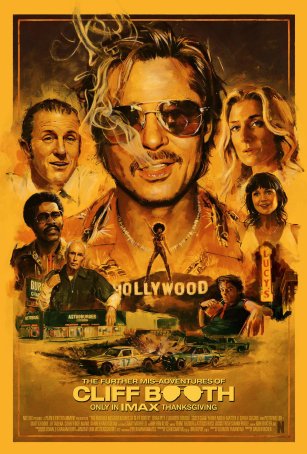
Although The Further Mis-Adventures of Cliff Booth is not technically a Quentin Tarantino film, it often feels like one. That is likely the result of director David Fincher opting to lean into the screenplay's sensibilities, channeling Tarantino's directorial style and littering the cinematic landscape with Easter eggs. Not only does the film feature the return of the title character from Once Upon a Time in Hollywood, but it also throws in references to Red Apple Cigarettes and Big Kahuna Burger, provides an update on the life and career of Rick Dalton (although a Leonardo DiCaprio cameo was nixed early on), and offers a fleeting glimpse of Sharon Tate in a TV commercial. Oh, and in what may be the most subversive nod, Fincher gives us a shot of Elizabeth Debicki's feet.
Unfortunately, despite extensive cutting and tinkering with an overlong script, the film never really comes into focus. There are crime elements, hangout scenes, comedic interchanges, and character study moments, yet the pieces don't fit together neatly. One of the great strengths of Tarantino's best movies is how seamlessly everything coalesces, generating a narrative momentum that pulls the viewer along wherever the story deigns to go. Here, there are too many fits and starts, with tangential sequences feeling wedged into the overall structure. While there are standout moments, the dialogue doesn't pop the way it usually does, and quite a bit of remaining fat could have been trimmed.
 This marks the fourth time a Tarantino-credited screenplay
has been handled by another director (though the writer-director had his
screenplay credit downgraded to "Story by" on Natural Born Killers,
which he subsequently disavowed). Unlike Tony Scott, Oliver Stone, or Robert
Rodriguez, however, Fincher actively works to craft a stylistic hybrid. The
central obstacle is that this is one of Tarantino's weaker storylines. The plot
meanders, and the subplot payoffs are either nonexistent or underwhelming. The
climax works well and the final line is gold (if predictable), but elements
like the central romantic attachment feel disjointed.
The Further Mis-Adventures of Cliff Booth opens in 1977. The events of Once Upon a Time in Hollywood are eight years in the past, Star Wars is dominating the box office, and stuntman Cliff Booth (Brad Pitt) continues to punish his body during the day while working as a Hollywood "fixer" by night. He lives a modest life, sharing a home with his cranky, aging father, Gus (Peter Weller), and pursuing a B&D liaison with Karen Crosby (Elizabeth Debicki), the assistant to TV star Charlie Peters (Scott Caan). Charlie wants to meet Cliff, although his motives are initially murky given Charlie's reputation for doing his own stunts. Eventually, the truth emerges: Charlie is in trouble with a pair of Filipino sociopaths (Matt Groove and JB Tadena) who have arrived in L.A. with an ultimatum that puts his wife, Toni (Carla Gugino), in danger. Cliff gets involved largely because of a shared past with Toni – something Charlie knows nothing about.
 One typically goes into a Tarantino project expecting four
things: offbeat hangout scenes, mounting tension, explosive violence, and
razor-sharp dialogue. The Further Mis-Adventures of Cliff Booth contains
elements of all four, yet only fully nails the violence. The tension is
intermittent, the hangout scenes lack the naturalism of, say, Jackie Brown,
and the dialogue tends to be more utilitarian than memorable. One notable
exception occurs when Karen argues why movies should be viewed as entertainment
rather than art (shades of how Roger Ebert felt about video games). Still,
nothing in the film comes close to the "Like a Virgin" debate in Reservoir Dogs or the "Royale with Cheese" exchange in Pulp Fiction.
Fincher's own sensibility is generally darker, less comedic, and more clinical than Tarantino's, and his voice comes through clearest in the physical darkness of the 1970s landscape. His recreation of the period is rich in tactile authenticity rather than relying on the facile shortcuts (hair, cars, needle drops) that many directors settle for. Consider, for example, the simple mechanics of 1970s landline telephones: dialing a rotary phone with one finger, walking across the room to answer a call, or hanging up one receiver after picking up another extension on the line.
 Brad Pitt owned the role of Cliff Booth in Once Upon a
Time in Hollywood, and he slides back comfortably into the character's skin
here. The other standout is Yahya Abdul-Mateen II as Roderick "Hot
Rod" Harrison. Despite limited screen time, he commands every scene in
which he appears. The two female leads, Debicki and Gugino, do the best they
can with underwritten roles; Debicki's Karen, in particular, feels as though
she lost half her arc somewhere along the way.
The movie opens with an exclusive two-week IMAX run, a format that allows the soundtrack and nightclub sequences to shine, before moving to Netflix. Although flush with big-screen polish, this isn't inherently a spectacle film and should play just as well in a modest home setup. Ultimately, while the Fincher-Tarantino collaboration doesn't reach the heights of either filmmaker's best work, it delivers an engaging piece of what Karen herself would call pure entertainment – a flawed, fascinating curio that coasts on Pitt's effortless charisma and Fincher's meticulous period craft even when its sprawling script doesn't fully cohere.
The Further Mis-Adventures of Cliff Booth (United States, 2026)
Cast: Brad Pitt, Elizabeth Debicki, Scott Caan, Yahya Abdul-Mateen II, Carla Gugino, Peter Weller, Matt Groove, JB Tadena
Screenplay: Quentin Tarantino
Cinematography: Erik Messerschmidt
Music: Trent Reznor, Atticus Ross
U.S. Distributor: Netflix
U.S. Release Date: 2026-11-25
MPAA Rating: "R" (Some strong/disturbing violence, bloody images, pervasive language, sexual content, nudity and drug use)
Genre: Thriller
Subtitles: none
Theatrical Aspect Ratio: 2.39:1
Comments