The Social Reckoning (United States, 2026)
October 09, 2026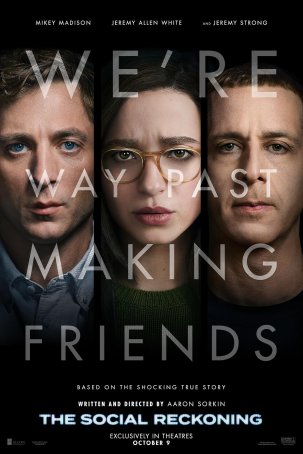
The Social Reckoning should not be mistaken for a sequel to The Social Network, despite some obvious synergies. The critically lauded 2010 film focused on Facebook founder Mark Zuckerberg. Although Zuckerberg (now played by Jeremy Strong) has a presence in The Social Reckoning, this is more of an investigative thriller like All the President's Men or Spotlight than a character-based piece. Unfortunately, the strands knitted together by writer/director Aaron Sorkin are sparse and indistinct. Because of the lack of real-world institutional change, there's no legitimate ending, so Sorkin invents a triumphant moment. It, like too much of the film, rings false, which is an odd thing to say about a movie that, at least on the surface, is based on the historical record. The problem with The Social Reckoning is that Sorkin never bothers to delve beneath the façade of any of his characters, and the little details he invents feel like a writer's constructs.
One of the structural problems faced by The Social Reckoning is that the narrative will be well-known to anyone who has followed the news over the past eight years. There's nothing new here and, unfortunately, nothing interesting. Explanations of Facebook's algorithm drown in technical jargon—my background allowed me to (mostly) follow things, but I can imagine 75% of the audience tuning out. And, frankly, the "revelations" associated with Facebook's methods are neither unique to this platform (they are repeated across all social media sites) nor surprising. The film also doesn't answer one basic question: Is the need for greater engagement/polarization purely financial, or is it to satisfy Zuckerberg's ego?
 The decision to pivot away from Zuckerberg for this film
might be a good choice; he was still an evolving character in The Social
Network, and Jesse Eisenberg's performance gave him nuance and an awkward
charisma. Here, he's portrayed as having a dead soul, dead eyes, and zero
personality. Sorkin's perspective of Zuckerberg circa 2019-21 is that he has
moved beyond humanity. It's almost as if he is AI-generated, and that's how
Strong plays him. The film's protagonists—Facebook employee/whistleblower
Frances Haugen (Mikey Madison) and investigative journalist Jeff Horwitz
(Jeremy Allen White)—are underwritten. They speak a lot of Sorkin-penned
dialogue but don’t say a lot. She claims she loves the idea of Facebook but has
become concerned about its direction. He rambles on about how he doesn't really
understand tech, but this doesn't seem like a primarily tech issue to him.
The decision to pivot away from Zuckerberg for this film
might be a good choice; he was still an evolving character in The Social
Network, and Jesse Eisenberg's performance gave him nuance and an awkward
charisma. Here, he's portrayed as having a dead soul, dead eyes, and zero
personality. Sorkin's perspective of Zuckerberg circa 2019-21 is that he has
moved beyond humanity. It's almost as if he is AI-generated, and that's how
Strong plays him. The film's protagonists—Facebook employee/whistleblower
Frances Haugen (Mikey Madison) and investigative journalist Jeff Horwitz
(Jeremy Allen White)—are underwritten. They speak a lot of Sorkin-penned
dialogue but don’t say a lot. She claims she loves the idea of Facebook but has
become concerned about its direction. He rambles on about how he doesn't really
understand tech, but this doesn't seem like a primarily tech issue to him.
The movie primarily covers the period during which Horwitz was writing and fact-checking what would become his Pulitzer Prize-winning Wall Street Journal series, The Facebook Files. After a prologue that feels like it was a deleted scene from Crash, the movie starts out pre-pandemic, quickly moves through a lengthy period when all the background characters are wearing masks, and climaxes with the January 6, 2021 insurrection—an event that feels shoehorned in despite its relevance. Facebook's complicity in events is germane, but the other social media networks (especially Twitter) aren't even mentioned, which seems a little odd, to say the least.
 Sorkin the director has never been nearly as good as Sorkin
the writer. His best work results when strong, capable filmmakers have given
life to his screenplays. In particular, I'm thinking of David Fincher with The
Social Network and Rob Reiner with A Few Good Men. The latter is
particularly relevant here because there are opportunities for a Tom
Cruise/Jack Nicholson-level confrontation that never materialize. At no point
does the power and energy evident in A Few Good Men surface. Everything
is strangely low-key, from the pace to the performances.
Sorkin the director has never been nearly as good as Sorkin
the writer. His best work results when strong, capable filmmakers have given
life to his screenplays. In particular, I'm thinking of David Fincher with The
Social Network and Rob Reiner with A Few Good Men. The latter is
particularly relevant here because there are opportunities for a Tom
Cruise/Jack Nicholson-level confrontation that never materialize. At no point
does the power and energy evident in A Few Good Men surface. Everything
is strangely low-key, from the pace to the performances.
Eisenberg's absence leaves a hole, although considering the limited role that Zuckerberg has in the movie, it's not a big one. (Eisenberg declined to return despite being heavily lobbied by Sorkin; he no longer wants to be associated with a figure he personally dislikes.) Mikey Madison is disappointingly bland, although one could argue that the problem is more the screenplay than Madison's performance. Frances Haugen is one-dimensional, and no attempt is made to flesh her out. A similar complaint could be lodged against Jeff Horwitz, who comes across as dull and uncharismatic—but is that Jeremy Allen White or Sorkin?
 The lack of narrative thrust and character depth argues that
this might have worked better as a documentary, although that would have
prevented Sorkin from employing his greatest strength: dialogue writing.
Unfortunately, this isn't his best work in that realm. There's not a lot here
that’s quotable or memorable (except perhaps the "mansplaining"
line). As a movie chronicling the investigation of a journalist, this falls
considerably short of All the President's Men (and "Fred"
isn't nearly as intriguing an alias for the source as "Deep Throat"),
but it tells its story and gets its point across about the dark side of social
media. Too bad it fails to do anything more compelling.
The lack of narrative thrust and character depth argues that
this might have worked better as a documentary, although that would have
prevented Sorkin from employing his greatest strength: dialogue writing.
Unfortunately, this isn't his best work in that realm. There's not a lot here
that’s quotable or memorable (except perhaps the "mansplaining"
line). As a movie chronicling the investigation of a journalist, this falls
considerably short of All the President's Men (and "Fred"
isn't nearly as intriguing an alias for the source as "Deep Throat"),
but it tells its story and gets its point across about the dark side of social
media. Too bad it fails to do anything more compelling.
The Social Reckoning (United States, 2026)
Cast: Mikey Madison, Jeremy Allen White, Jeremy Strong, Wunmi Mosaku, Betty Gilpin, Billy Magnussen, Bill Burr, Anna Lambe
Screenplay: Aaron Sorkin
Cinematography: Jeff Cronenweth
Music: Alexandre Desplat
U.S. Distributor: Columbia Pictures
U.S. Release Date: 2026-10-09
MPAA Rating: "R" (Language)
Genre: Drama
Subtitles: none
Theatrical Aspect Ratio: 2.39:1
- Anora (2024)
- (There are no more better movies of Mikey Madison)
- Scream (2022)
- (There are no more worst movies of Mikey Madison)
- After Everything (2018)
- Iron Claw, The (2023)
- (There are no more better movies of Jeremy Allen White)
Comments