The Odyssey (United States/United Kingdom, 2026)
July 17, 2026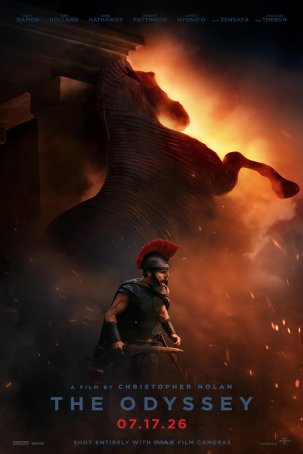
Christopher Nolan's The Odyssey is a three-hour refutation of James Cameron's fallacious assertion that 3-D is necessary for complete cinematic immersion. On even a conventional screen, Nolan's reworking of Homer's epic tale towers over the audience, drawing viewers in with its combination of striking visuals and throbbing sound, emphasized in no small part by Ludwig Göransson's forceful score. And all this without the need to wear cumbersome glasses.
Nolan's "and now for something completely different" approach to project selection is much in evidence here. The Odyssey is nothing like Oppenheimer, which, in turn, was a far cry from Tenet. This movie takes a deep dive into Greek mythology, embellishing the adaptation of the source material with smatterings of The Iliad, Virgil's The Aeneid, and Nolan's own stylings. The melding and modernization of sources mostly works, although the structure at times feels a little unwieldy, delivering a heroic quest through a lost era of gods and monsters. Unlike Clash of the Titans, the deities are not in the forefront. And unlike Troy, they are not altogether absent.
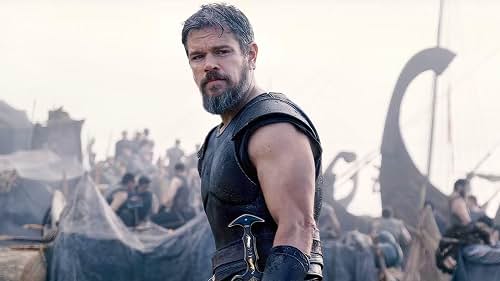 The storyline uses the structure of the original as a sort
of template, staying close to the main plot points while crafting an
interpretation designed to have mainstream appeal for modern audiences. (Truthfully,
a more literal adaptation of The Odyssey would almost certainly be a box
office failure.) At the core of the narrative is the post-Troy, decade-long
journey of Odysseus (Matt Damon), the king of Ithaca, to reach his home after
being lost at sea and marooned on an island with the nymph Calypso (Charlize
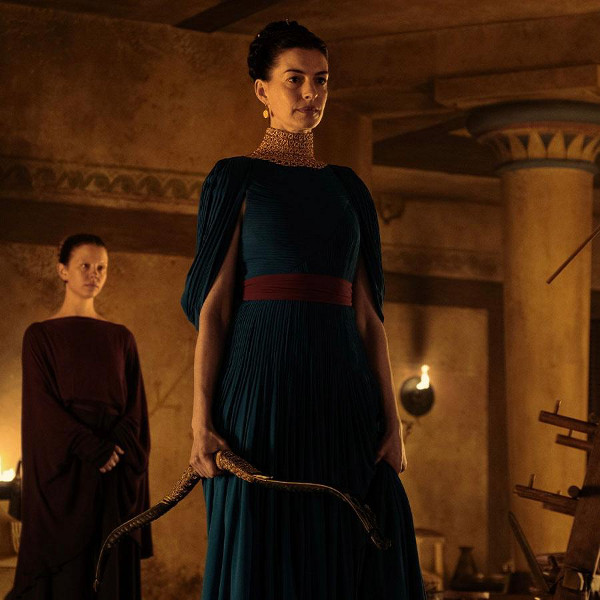
Theron) as his lone companion and captor. In Odysseus's absence, his wife,
Penelope (Anne Hathaway), has fought the pressure to remarry one of the
numerous suitors who daily crowd her court. Among them is the odious Antinous
(Robert Pattinson), who delights in tormenting Odysseus's son and heir,
Telemachus (Tom Holland).
The storyline uses the structure of the original as a sort
of template, staying close to the main plot points while crafting an
interpretation designed to have mainstream appeal for modern audiences. (Truthfully,
a more literal adaptation of The Odyssey would almost certainly be a box
office failure.) At the core of the narrative is the post-Troy, decade-long
journey of Odysseus (Matt Damon), the king of Ithaca, to reach his home after
being lost at sea and marooned on an island with the nymph Calypso (Charlize
Theron) as his lone companion and captor. In Odysseus's absence, his wife,
Penelope (Anne Hathaway), has fought the pressure to remarry one of the
numerous suitors who daily crowd her court. Among them is the odious Antinous
(Robert Pattinson), who delights in tormenting Odysseus's son and heir,
Telemachus (Tom Holland).
Although the gods themselves are frequently name-checked, the only one seen on-screen is Athena (Zendaya). In the poem, she is a very real presence, but the movie is ambiguous about whether she truly manifests to Odysseus or exists merely in his imagination. The monsters, however, are anything but background elements. Creatures such as the cyclops, the witch Circe (Samantha Morton), the multi-headed Scylla, and a horde of the dead provide tangible adversaries for the king. In a strange way, The Odyssey could be seen as a sweeping fantasy road trip, except in this instance, the destination is as important as the journey.
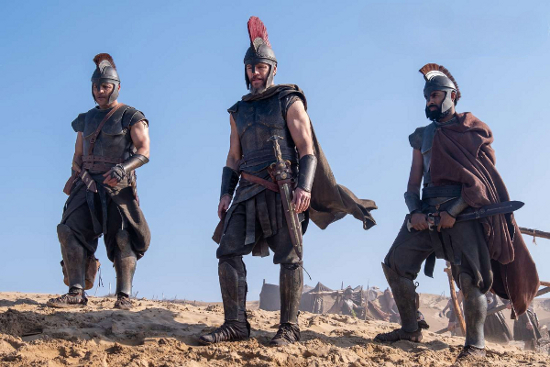 By limiting the use of digital tools like CGI, Nolan creates
an experience with texture. When characters are ascending toward great heights,
there's little doubt that the actors are making the climb. The downside of
this, of course, is that location shooting and practical effects can be
extraordinarily expensive, but at least one can see the fruits of the enormous
budget on-screen. Unlike many of this year's fizzled would-be blockbusters,
this one deserves the moniker (regardless of how well it performs financially).
By limiting the use of digital tools like CGI, Nolan creates
an experience with texture. When characters are ascending toward great heights,
there's little doubt that the actors are making the climb. The downside of
this, of course, is that location shooting and practical effects can be
extraordinarily expensive, but at least one can see the fruits of the enormous
budget on-screen. Unlike many of this year's fizzled would-be blockbusters,
this one deserves the moniker (regardless of how well it performs financially).
Nolan's decision to follow the poem's structural approach of using flashbacks to fill in the backstory while moving the plot forward creates some issues, especially early in the film. As the movie tries to introduce a large number of characters and establish settings in both the past and present, the emotional resonance is sidelined. Viewers are forced into about 20 minutes of processing before the filmmaking power starts to emerge. Although it's difficult to see that a straight chronological approach would have worked better, there's something a little jarring about all the time-jumps and switching between characters.
 The Odyssey contains three standout scenes (with
numerous other strong moments sprinkled throughout). The first is the
confrontation with the cyclops, where Odysseus shows both his clever and
vengeful sides. The second is the Trojan horse sequence, which is unlike any
previous re-creation of this (in)famous event. (For the first time, we are
presented with a credible depiction of the deprivation endured by those inside
the wooden beast.) The third is the climactic battle, which allows The
Odyssey to reach a conclusion that justifies the running time.
The Odyssey contains three standout scenes (with
numerous other strong moments sprinkled throughout). The first is the
confrontation with the cyclops, where Odysseus shows both his clever and
vengeful sides. The second is the Trojan horse sequence, which is unlike any
previous re-creation of this (in)famous event. (For the first time, we are
presented with a credible depiction of the deprivation endured by those inside
the wooden beast.) The third is the climactic battle, which allows The
Odyssey to reach a conclusion that justifies the running time.
Nolan has added layers of nuance to the lead character that are not necessarily evident in the poem. Shadings of regret develop as Odysseus's reminiscences reflect a darker perspective of war. Here, one can see a shared thematic thread with Oppenheimer: both movies are about towering figures who come to see the horrors that have emerged from their greatest successes. Odysseus looks back on Troy not only as a military victory but as a source of spiritual anguish as his memories catalog the atrocities he witnessed in its aftermath.
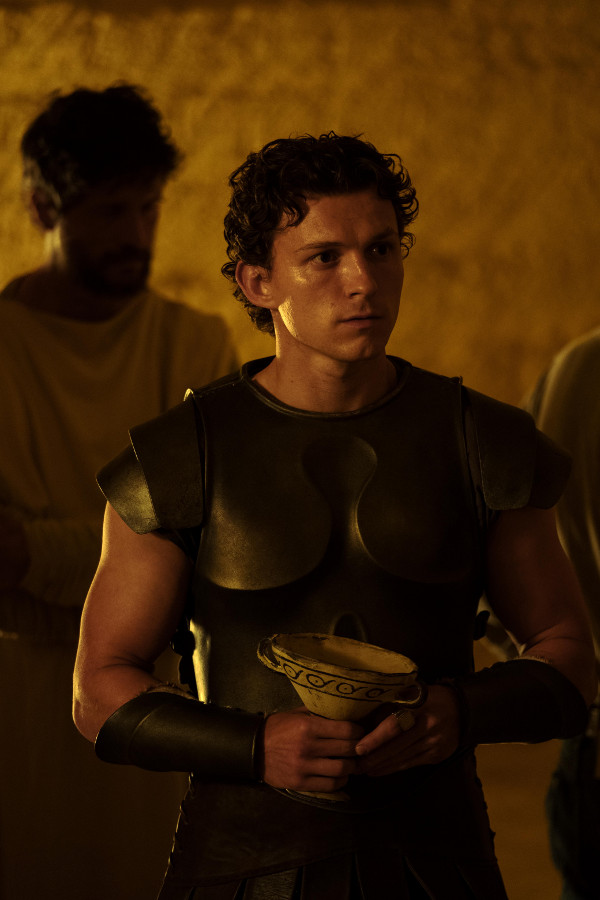 The film has only one lead: Matt Damon. In one of his
best-realized and strongest dramatic performances, Damon shrugs aside past
criticisms about his range and fully inhabits a character who is simultaneously
brave, powerful, and haunted. Strong support is provided by Robert Pattinson,
whose Antinous is truly repulsive; Anne Hathaway, who imbues Penelope with both
strength and sadness despite limited screen time; and Tom Holland, whose
Telemachus shows growth as he seeks to protect his mother, honor his absent
father, and stay alive. Three particular casting choices that have been derided
in some corners of social media prove to be non-issues. This is partly because
all of them are fine in their roles, and partly because their screen time is so
limited. Lupita Nyong'o's Helen of Troy and Zendaya's Athena have only a
handful of scenes and minimal dialogue. Elliot Page has a slightly larger role,
but his performance is distracting only to those who intend for it to be so.
The film has only one lead: Matt Damon. In one of his
best-realized and strongest dramatic performances, Damon shrugs aside past
criticisms about his range and fully inhabits a character who is simultaneously
brave, powerful, and haunted. Strong support is provided by Robert Pattinson,
whose Antinous is truly repulsive; Anne Hathaway, who imbues Penelope with both
strength and sadness despite limited screen time; and Tom Holland, whose
Telemachus shows growth as he seeks to protect his mother, honor his absent
father, and stay alive. Three particular casting choices that have been derided
in some corners of social media prove to be non-issues. This is partly because
all of them are fine in their roles, and partly because their screen time is so
limited. Lupita Nyong'o's Helen of Troy and Zendaya's Athena have only a
handful of scenes and minimal dialogue. Elliot Page has a slightly larger role,
but his performance is distracting only to those who intend for it to be so.
For those who are familiar with the source material—which I'd estimate at being less than 1% of the total audience—it's fascinating to see some of the choices made by Nolan and understand how certain departures work well within the framework of a motion picture. For those coming into this with a fresh perspective, The Odyssey represents a rousing fantasy film that builds an amazing world and illustrates the perilous voyage of a singular character across it. The movie has something that too many films lack: momentum. Like a rolling stone gathering no moss, it starts out slowly but steadily builds. With this film, Nolan reminds us that motion picture events need not rely on established characters, gimmicky stylistic choices, or effects of dubious quality. This is a modern interpretation of old-fashioned filmmaking at its finest, and it results in one of the year's most consistently engaging epics.
The Odyssey (United States/United Kingdom, 2026)
Cast: Matt Damon, Tom Holland, Anne Hathaway, Robert Pattinson, Charlize Theron, Jon Bernthal, Zendaya
Screenplay: Christopher Nolan
Cinematography: Hoyte van Hoytema
Music: Ludwig Göransson
U.S. Distributor: Universal Pictures
U.S. Release Date: 2026-07-17
MPAA Rating: "R" (Violence and some language)
Genre: Fantasy/Adventure
Subtitles: none
Theatrical Aspect Ratio: 2.39:1
Comments